The Sri Yantra is the most powerful of all Yantras, so it is also called the king yantra. It is considered a highly effective tool for meditation, contemplation, and concentration.
The Sri Yantra should have a strong influence on success, power, authority as well as a financial success if these aspects are to be achieved within the framework of an honest, careful and peaceful action.
SHREE means Sanskrit prosperity and YANTRA instrument – consequently, it is a graphical instrument for achieving prosperity. The notion of prosperity is, however, not only for the material but also, or primarily, with the nonmaterial, spiritual and spiritual. Meditating on the Sri Yantra helps us on the way to prosperity, harmony and inner peace.
The Sri Yantra is also referred to as the Sri Chakra, as it is considered the primordial Yantra, the mother of all the other yantras that derive from it. The three-dimensional form of the Sri Yantra is to represent Mount Meru, the mystical, cosmic mountain in the center of the universe. Sri Yantra is a representation of creation and is connected with the tree of life. The energetic effect of Sri Yantra should be seventy times larger than that of a pyramid.
The Sri Yantra could be understood as a place of spiritual pilgrimage – it represents the cosmos on the macrocosmic level and the human body on the microcosmic level.
The Sri Yantra is a graphical configuration of nine triangles, composed of two lotus petals, and this in turn from a surrounding gateway, called the “citadel of the earth”. The four upright triangles symbolize Shiva – the male principle the nine interlocking triangles around the Bindu, the central core of the Yantra. In the center are five downward triangles, which represent the Shakti, the female principle. The nine interlocked triangles again form 43 smaller triangles, each with a divine principle with specific aspects.
The aim of the contemplation of Sri Yantra is to discover its innermost sources to promote the process of becoming.
The Sri Yantra is used as part of meditation as a visual aid for the concentration of the mind.
Today’s tutorial, How to Draw a MANDALA by Elsa Rhae, gives you lots of pointers in what to do to make “mistakes” into a beautiful, balanced mandala image. It’s a quick and fun tutorial for all you you who think, “I can’t draw. How can I create one of those beautiful, symetrical mandalas that I see others doing?”
F I L M I N G E Q U I P M E N T:
Nikon D600
Nikon 24-85mm Lens
Diva Ring Light
Softbox Light Kit
Sennheiser MKE 600 mic
Zoom h4n audio recorder
Macbook Pro 2014
Adobe Premiere Pro
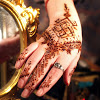
According to Wikipedia: “Mehndi or “Mehendi” or henna is a paste that is created from the powdered leaf of the henna plant and is made into designs for men and women. Mehndi is derived from the Sanskrit word mendhikā. The use of mehndi and turmeric is described in the earliest Hindu Vedic ritual books. It was originally used for only women’s palms and sometimes for men, but as time progressed, it was more common for men to wear it. ”
“Mehndi in Indian tradition is typically applied during special Hindu weddings and Hindu festivals like Karva Chauth, Vat Purnima, Diwali, Bhai Dooj and Teej. In Hindu festivals, many women have Henna applied to their hands and feet and sometimes on the back of their shoulders too, as men have it applied on their arms, legs, back, and chest. For women, it is usually drawn on the palm, back of the hand and on feet, where the design will be clearest due to contrast with the lighter skin on these surfaces, which naturally contain less of the pigment melanin.”

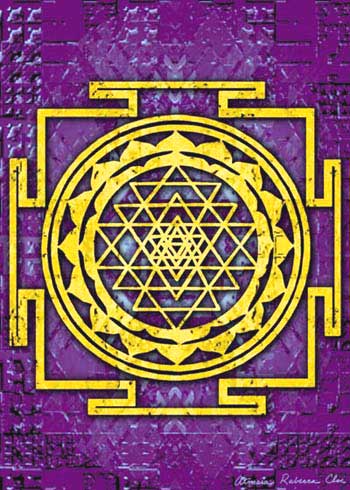 The Sri Yantra is the most powerful of all Yantras, so it is also called the king yantra. It is considered a highly effective tool for meditation, contemplation, and concentration.
 To see more of