by atmara | Feb 9, 2012 | TED Talks, Video
 For those of you not familiar with TED Talks here is a brief summery of them from www.ted.com:
“TED is a small nonprofit devoted to Ideas Worth Spreading. It started out (in 1984) as a conference bringing together people from three worlds: Technology, Entertainment, Design. Since then its scope has become ever broader. Along with two annual conferences — the TED Conference in Long Beach and Palm Springs each spring, and the TEDGlobal conference in Oxford UK each summer — TED includes the award-winning TEDTalks video site, the Open Translation Project and Open TV Project, the inspiring TED Fellows and TEDx programs, and the annual TED Prize”
According to According to www.ted.com:
“Seth Godin argues the Internet has ended mass marketing and revived a human social unit from the distant past: tribes. Founded on shared ideas and values, tribes give ordinary people the power to lead and make big change. He urges us to do so.”
“Seth Godin is an entrepreneur and blogger who thinks about the marketing of ideas in the digital age. His newest interest: the tribes we lead.”
Enjoy!
——————————————————————————————————–
I look forward to your thoughts and comments!
Be sure to Subscribe to this blog either by RSS or Email via the forms on the top right column of the page.
by atmara | Feb 6, 2012 | Art, Mandala Monday, Mandalas
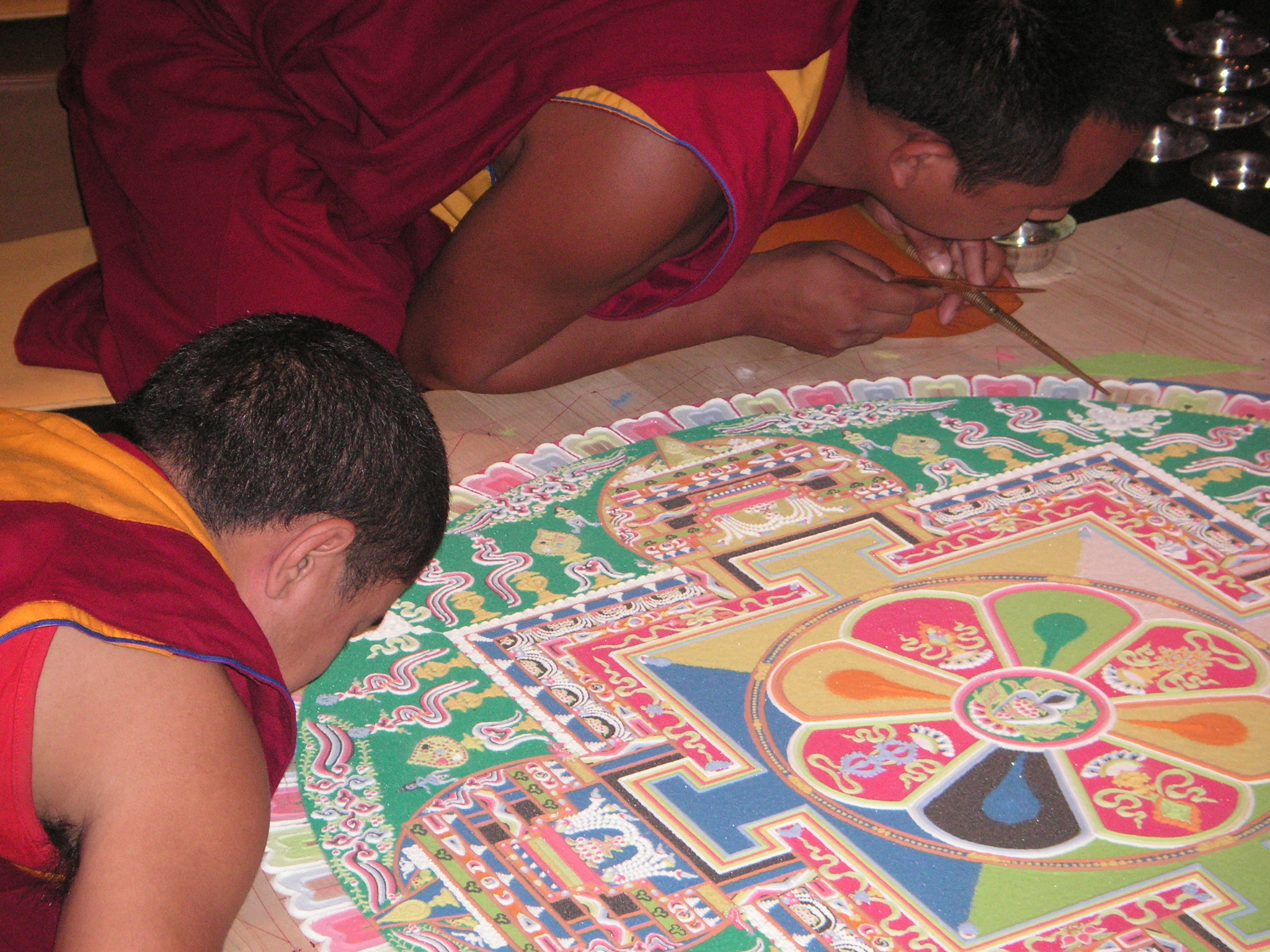
Can you imagine spending several hours, days, or even weeks on a work of art, and then destroying it? The idea of creating something only to wipe it out when you’re finished is illogical and counterproductive to many people in the Western world. But in some cultures, this is a common procedure, and one that serves a deeper purpose than meets the eye.
Sand painting is the perfect example of ephemeral art – that is, art that is meant to be temporary. To create a sand painting, colored sand is poured carefully into predetermined patterns. Sand painting is a common practice amongst many diverse indigenous cultures from around the world, including the Australian Aborigines, the Native Americans, and the Tibetans, as shown above. Tibetan sand painting is a perfect example of making art that values ‘process’ over ‘product’. In the Western world, it’s often the opposite – artists labor over paintings for the purpose of selling them for profit. The art, even though it may be a labor of love, is also a ‘product’. The ‘process’ of making art is treated as a means to an end. In Tibetan sand painting, the process of creating the intricate sand mandalas is far more important than the final product. Tibetan sand paintings are created by Buddhist monks for ritual purposes related to healing and blessing. As the sand mandalas are painstakingly created, viewers are often allowed to watch and admire the precision of the artists and the beauty of the design. Destroying the finished sand mandalas contains a ritual purpose as well; it is a lesson on impermanence. Perhaps artists from Western cultures can benefit from some of these ideas by paying closer attention to the process of making art, rather than worrying about how the final product will turn out.
Article Source: http://www.articlesbase.com/art-articles/the-art-of-tibetan-sand-painting-4297166.html
About the Author
Mark Feldman is President of SegTech, a company devoted to a wonderful Image Segmentation technology called Segmation. Segmation – The Art of Pieceful Imaging
Paint-by-numbers meets modern technology in SegPlay® PC, a computerized paint-by-numbers program for Windows 7, Vista, XP and 2000. With twenty built in images and powerful features for artsy types and casual gamers, SegPlay® PC is simple to use with infinite variety.
There are also hundreds of available add-on patterns for SegPlay® PC organized in over 100 categories from famous historical artists to colorful illustrations to natural photographic scenery.
Play online for free!
Visit our website: http://www.segmation.com
Read our blog: http://segmation.wordpress.com
Join us on Facebook: http://www.facebook.com/segmation
——————————————————————————————————–
I look forward to your thoughts and comments!
Be sure to Subscribe to this blog either by RSS or Email via the forms on the top right column of the page.
by atmara | Feb 2, 2012 | TED Talks, Video
For those of you not familiar with TED Talks here is a brief summery of them from www.ted.com:
“TED is a small nonprofit devoted to Ideas Worth Spreading. It started out (in 1984) as a conference bringing together people from three worlds: Technology, Entertainment, Design. Since then its scope has become ever broader. Along with two annual conferences — the TED Conference in Long Beach and Palm Springs each spring, and the TEDGlobal conference in Oxford UK each summer — TED includes the award-winning TEDTalks video site, the Open Translation Project and Open TV Project, the inspiring TED Fellows and TEDx programs, and the annual TED Prize”
According to www.ted.com:
“Physicist Brian Greene explains superstring theory, the idea that minscule strands of energy vibrating in 11 dimensions create every particle and force in the universe.”
“Greene, a professor of physics and mathematics at Columbia University, has focused on unified theories for more than 25 years, and has written several best-selling and non-technical books on the subject including The Elegant Universe, a Pulitzer finalist, and The Fabric of the Cosmos—each of which has been adapted into a NOVA mini-series. His latest book, The Hidden Reality, explores the possibility that our universe is not the only universe.
Greene believes science must be brought to general audiences in new and compelling ways, such as his live stage odyssey, Icarus at the Edge of Time, with original orchestral score by Philip Glass, and the annual World Science Festival, which he co-founded in 2008 with journalist Tracy Day.”
Enjoy his talk:
——————————————————————————————————–
I look forward to your thoughts and comments!
Be sure to Subscribe to this blog either by RSS or Email via the forms on the top right column of the page.