by atmara | Jan 9, 2012 | Art, Healing, Mandala Monday, Mandalas
The MARI (Mandala Assessment Research Instrument) is the most comprehensive psychological assessment available today. It is an integrative approach based on the concepts of C.G. Jung, Mandalas, archetypes and evolutionary biology and psychology.
MARI Creative Resources provides teaching and training programs that encourage wellness in mental health based on the MARI psychological assessment. The goal is to provide a quality training program and excellent service in the administration of teacher training and certification. MARI also promotes creativity and innovation within the organization, particularly in areas that promote practitioner satisfaction and continuing education, by providing products and services at a reasonable cost.
The Mandala Assessment Research Instrument is rooted the research and systematic study of thousands of client-drawn mandalas. This research was implemented and conducted by art therapist Joan Kellogg in the 1970’s. The MARI as we know it now first took form in Joan’s Master’s thesis in the 1980’s. Since its invention, the MARI has been continually researched, modified and enhanced for over roughly twenty years with input by the many different therapists who use the MARI with clients. The MARI, as it exists today, will continue to disclose itself and evolve over time. The MARI is a comprehensive system that uses symbols, known as mandalas, to reveal the inner truth and reality of the subject as it is -not what the ego filters of consciousness would want it to be- but how it really is. Carl Jung, world renowned psychiatrist, recognized the mandala as “the centre of personality, a kind of central point within the psyche, to which everything is related, by which everything is arranged and which is, itself, a source of energy.” Jung’s description of the mandala is also an excellent description of the MARI. In addition to symbols, the MARI® is comprised of colors and stages of development. The relationship of these variables creates a visual ‘snapshot’ of the self as experienced in the present moment. This visual relationship is best understood by addressing each variable separately.
For more information, visit the website at www.maricreativeresources.com
——————————————————————————————————–
I look forward to your thoughts and comments!
Be sure to Subscribe to this blog either by RSS or Email via the forms on the top right column of the page.
by atmara | Jan 5, 2012 | Creativity, TED Talks, Video
 For those of you not familiar with TED Talks here is a brief summery of them from www.ted.com:
“TED is a small nonprofit devoted to Ideas Worth Spreading. It started out (in 1984) as a conference bringing together people from three worlds: Technology, Entertainment, Design. Since then its scope has become ever broader. Along with two annual conferences — the TED Conference in Long Beach and Palm Springs each spring, and the TEDGlobal conference in Oxford UK each summer — TED includes the award-winning TEDTalks video site, the Open Translation Project and Open TV Project, the inspiring TED Fellows and TEDx programs, and the annual TED Prize”
According to www.ted.com:
“Games like World of Warcraft give players the means to save worlds, and incentive to learn the habits of heroes. What if we could harness this gamer power to solve real-world problems? Jane McGonigal says we can, and explains how.”
“Jane McGonigal asks: Why doesn’t the real world work more like an online game? In the best-designed games, our human experience is optimized: We have important work to do, we’re surrounded by potential collaborators, and we learn quickly and in a low-risk environment. In her work as a game designer, she creates games that use mobile and digital technologies to turn everyday spaces into playing fields, and everyday people into teammates. Her game-world insights can explain — and improve — the way we learn, work, solve problems, and lead our real lives.”
See what you think:
——————————————————————————————————–
I look forward to your thoughts and comments!
Be sure to Subscribe to this blog either by RSS or Email via the forms on the top right column of the page.
by atmara | Jan 2, 2012 | Art, Inspiration, Mandala Monday, Mandalas
Mandala (Sanskrit mandala “essence” +”having ” or “containing” it is also translated as “circle- circumference” or “completion”, both derived from Tibetan term dkyil khor). Mandala is of Hindu origin, the term being used for the books of the Rig Veda but is also used in other Indian religions such as Buddhism. In the Tibetan branch of Vajrayana Buddhism, mandalas have been developed into sandpainting. They are also a key part of anuttarayoga tantra meditation practices.
In various spiritual traditions, mandalas may be employed for focusing attention of aspirants and adepts; as a spiritual teaching tool; for establishing a sacred space; and as an aid to meditation and trance induction.
its symbolic nature can help one “to access progressively deeper levels of the unconscious, ultimately assisting the meditator to experience a mystical sense of oneness with the ultimate unity from which the cosmos in all its manifold forms arises.” The psychoanalyst Carl Jung saw the mandala as “a representation of the unconscious self,” and believed his paintings of mandalas enabled him to identify emotional disorders and work towards wholeness in personality.
In common use, mandala has become a generic term for any plan, chart or geometric pattern that represents the cosmos metaphysically or symbolically, a microcosm of the Universe from the human perspective.
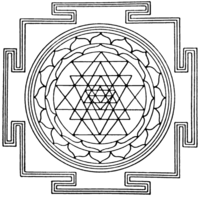 Sri Yantra
Sri yantra is called the mother of all yantras because all other yantras derive from it. The Sri Yantra is a configuration of nine interlacing triangles centred around the bindu (the central point of the yantra), drawn by the super imposition of five downward pointing triangles, representing Shakti ; the female principle and four upright triangles, representing Shiva ; the male principle. Man’s spiritual journey from the stage of material existence to ultimate enlightenment is mapped on the Sri Yantra. The spiritual journey is taken as a pilgrimage in which every step is an ascent to the center, a movement beyond one’s limited existence, and every level is nearer to the goal.
Each of the circuits of the Sri Yantra, from the outer plane to the bindu (the center), corresponds with one of the stages of the spiritual journey.
The goal of contemplating the Sri Yantra is that the adept can rediscover his primordial sources. The circuits symbolically indicate the sucessive phases in the process of becoming.
Prerna School of Inspiration – Temple of Inspiration located at : C-136, Khasra Number-198 Chattarpur Enclave New Delhi – 110074 9958710730 aartikhosla12@gmail.com http://www.prernaschoolofinspiration.com/
Image from Wikimedia Commons
——————————————————————————————————–
I look forward to your thoughts and comments!
Be sure to Subscribe to this blog either by RSS or Email via the forms on the top right column of the page.