by atmara | Mar 26, 2012 | Art, Creativity, Mandala Monday, Mandalas

By Paul Epstein, Bay Nature
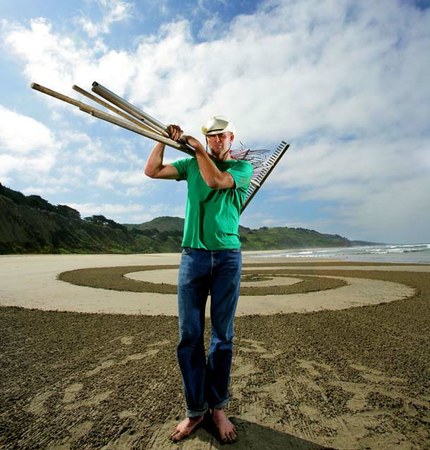
Now you see it. Now you don’t. Jim Denevan creates art — very large art — out of the most ephemeral media: patterns in sand which will wash away with the tide, tracings in the earth that will disappear with the first rain, etchings upon icy lakes that must melt with the coming of spring.
Beach aficionados know him as “that surfer dude” or “the guy on Ocean Beach.” Also a chef and an organic farmer, he is one of the founders of Outstanding in the Field, which aims to reconnect diners with the source of their food.
He has been compared to several artists. Like Christo, whose “Running Fence” transected Marin and Sonoma counties in the early and mid-1970s, and whose “Umbrellas” pocked hillsides and rice paddies on two continents in the mid-1980s and early 1990s, Denevan’s work is of enormous scale, and plays in, on and among natural features. Like Andrew Goldworthy, his work is composed entirely of natural materials patterned in striking geometric shapes. Others have likened his work to the sand mandalas of Tibetan Monks, to “alien” crop circles and to graffiti.
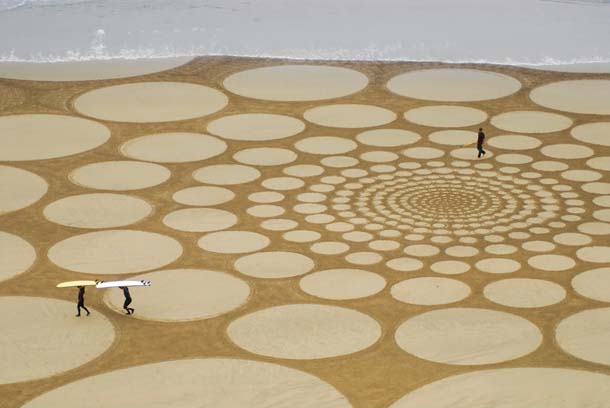
BAY NATURE:You’re from Santa Cruz, a community that is largely oriented around its beaches. How do you think your hometown has affected your outlook on art and on nature?
DENEVAN: The ocean, of course, is constantly changing, and the conditions of the waves and the wind and the weather. I think of nature as something that is changeable from season to season.
I grew up in San Jose. There were a lot of suburban developments, but I grew up next to
the Guadalupe River. When I was a kid there was practically no one down there checking things out. So I would make little constructions in nature, doing things with the water, and little dams, and coming back every season, the dams were destroyed in the winter. That’s the origin of my interest in imposing things on nature.
BN: The work that you do is made exclusively of natural media, mostly sand, eah and snow. How does this affect the process and the outcome of your work?
DENEVAN: It’s just as fascinating at the time of its destruction as the other aspects of making it and composing the work. At the beach, the tide is pretty regular. But I have done things where there’s also weather, a forecast for rain. In its disintegration, it’s interesting. A sand drawing on the beach when it’s half-destroyed is interesting.
I can see that change happen more quickly, in terms of a day or a week. That includes our lives. We go from being adolescents to young adults to middle aged through the human life span and a work of art has a birth and an existence and a death.
BN: What is the intention of your arthttp://www.baycitizen.org/partners/bay-nature/?
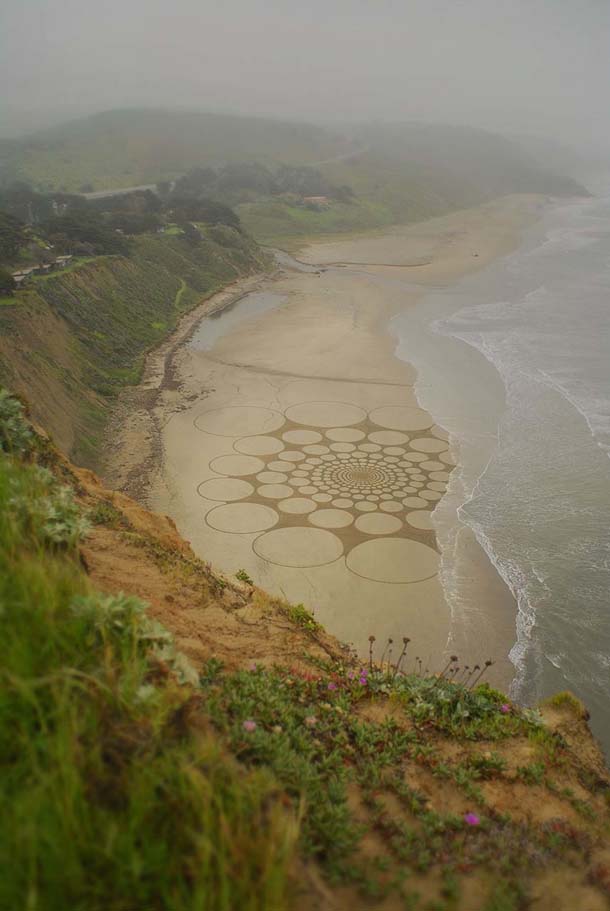
DENEVAN:A few different things: Recently I did a drawing at Ocean Beach [in San Francisco].
There’s an aspect of the art, especially when it’s done in a public area, that people can visit, they can compose themselves within the artwork. The artwork will have some relation to the size of a person’s body. And the compositional elements provide a path by which they can explore the relationship of their body to the composition. Drawing in the sand is very human, it’s gentle and it’s grand at the same time.I went out two days ago for the first time in a long time and it was very, very soothing to me, very peaceful. And also it’s physically challenging to walk for a period of hours, and to use my strength to push the sand. It’s fulfilling to complete something. It’s difficult.
I have been doing this for almost 18 years now, and I have kind mixed feelings about it now. I have made a substantial amount of money in the last year doing commissions in different places in the world. But generally there’s no money to be made; there’s no photograph to be sold.
BN: When people, dogs, and frisbees come through, is that annoying?
DENEVAN: I consider the people something like the waves in the erosion of the drawing, meaning that I appreciate their interest and their comments, but can’t control what they’re going to be doing at the beach, with digging holes or who knows what. And I never stop anyone from playing volleyball.
BN: Of all the different art that you have done in the Bay Area, which one has been the most meaningful to you, and why?
DENEVAN: I have to say the drawings I’ve done on Ocean Beach. I really appreciate when people have come into the artwork and experienced it for themselves, and the comments that they make, and the appreciation they have for what I’m doing. It’s a little overwhelming. It’s probably why I don’t do it all that much.
BN: Most people are very enthusiastic about your work. Some have compared your work, perhaps critically, to either Christo or Goldworthy; or alien crop circles or Buddhist sand mandalas. What do you make of those comparisons?
DENEVAN: Well, the first thing that comes to mind is that it’s a similar impulse that I have to those that you listed. I think Christo and Goldsworthy, and certainly Australian Aboriginals or Tibetan Monks, are concerned with similar questions. It’s inevitable that expression is going to evolve that’s going to be personal.
BN: If you could have access to any site in the Bay Area, and do any kind of composition there, suspending the usual laws, permitting rules and social norms, where would you choose and what would you do?
DENEVAN: Something that I’ve been thinking about for a while is the salt ponds in the South Bay. When you fly in, you see the various colors that exist. What I would do is have brilliantly different colored circles, using the different times of the salt production. I’ve done a little research into that and actually, I’ve been meaning to go down there and walk around and get a feel for that whole area. I don’t think anyone would argue against that. I think it would be fun and interesting and very beautiful, with the bright colors.
BN: What are the challenges you face in your work?
DENEVAN: I’ve had people that have been drinking alcohol on the beach and they come up to me and try to ask me questions when I’m trying to concentrate.
And then I’ll go up to a high spot, and I’ll see the mark of where the conversation was, where I lost my concentration. And you can see where the drawing went off course, which I think is kind of fascinating and I can’t get mad. It would ruin it.
BN: How does your work affect the viewer’s perceptions of the local environment
DENEVAN: It touches them because it brings them closer to something I think they already know, but maybe don’t see so much in their daily life, that things – whether they’re culture or nature – are transitory. They will be transforming to something else, and therefore, personally when people are experiencing the artwork, they are recognizing their temporality, and that blends into the perception of – and the experience of – the day, and the experience of the specificity of one day, one day in one life.
BN: Is there anything else that you would like to say?
DENEVAN: I’m just excited and fascinated with the world and nature and how it is that I’m alive. I feel that when somebody walks into a sand drawing, we’re all in the same place. I mean maybe physically, walking into the sand drawing, but also in the sense that we’re human, that we can be sick, that we can die, that we can be injured; we’re all part of the physical phenomena of the world, in a temporal sense.
By Paul Epstein, Bay Nature


———————————————————————————————————
I look forward to your thoughts and comments!
Be sure to Subscribe to this blog either by RSS or Email via the forms on the top right column of the page.
Like this:
Like Loading...
by atmara | Mar 19, 2012 | Art, Inspiration, Mandala Monday, Mandalas, Sacred Geometry
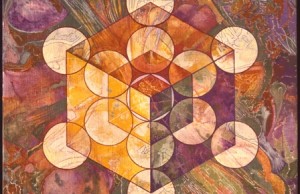
By Charles L. Gilchrist
I have been deeply involved with the study of Sacred Geometry for over thirty years. This experience has radically altered my consciousness and affected a profound psychological healing. And, as a teacher of SG I have personally witnessed the same kind of beneficial effects taking place in many of my students. This fact compels me to share my path into SG as a spiritual process. Why? Because I know that with this information, you can also step through these reliable doorways to spirit and make them your own.
I’ve always been an artist and that path eventually lead me to Sacred Geometry. My artistic talent showed itself early and by the time I was four years old I had come to believe that a special talent had been given to me for some mysterious spiritual purpose; as if it were an assignment straight from God. I was totally convinced. With an enthusiastically willing heart I took on the spiritual assignment of becoming a serious artist.
But what was an artist…. really? I was just a little boy and I had no idea how to make my inspired vision come true. So I went to my mother with the obvious question. “Mommy, what is an artist?”
At first she smiled at me and then squinted at me, guarded and thinking. I had been asking metaphysical questions of her from the time I could speak. Each question of mine would prompt another question and so on until she would completely lose her patience with me. She looked up at the ceiling, her forefinger just touching her temple as if searching her invisible mental library for the most appropriate answer. Finally her eyes brightened as she pulled out a dusty old one-liner and read it to the ceiling. “Charles,” she said, “an artist pursues truth and beauty.”
Then she softened, looked straight into my eyes and said it again, “Charles, an artist pursues truth and beauty.”
That short axiom was like a clear bell. “Oh,” is all I could say, intuitively sensing profound truth. And now after all these numerous decades, it still holds the same power.
In Wichita Kansas, the early 1940′s, my entire large family did not think making art was at all practical. After all, there was real work to do; food to grow, machines to build and a war to win. It was alright have a little artistic talent which could lead to a nice hobby but the idea of even thinking about “Fine Art” as a profession was simply unacceptable. They went on and on, trying to dissuade me. I think they actually believed that if I became a full time serious artist I would eventually go completely mad and cut off my ear like that poor insane maniac artist “what’s-his-name” Vincent Van Gogh. They were frightened…. but I wasn’t.
Regardless of their fear, I pressed on. In the early 1950′s I was a teenager living in the Chicago area. It was then I discovered the surrealist painters. I read library books with countless reproductions of the surrealist works by Max Ernst, Jean Arp, Man Ray, Joan Miro, Yves Tanguy, Rene Magritte, Alberto Giacometti. Salvador Dali, etc. I was totally fascinated by the surrealists because they were investigating their own internal dream worlds, their subconscious imagery. This kind of thinking struck a nerve in me and, at that point, I thought of myself as a “Surrealist”. I could feel the serious TRUTH of honest self-investigation.
Then high school, art school, marriage and fatherhood. The practical necessities of life had finally caught up with me. I became a professional portrait photographer out of necessity and immediately began to make a decent living. The family was happy as I had apparently started to become respectable. I stopped making serious art and turned to photographic commerce. Surrealism was now the last thing on my conscious mind.
The 1960′s however, upset my comfort zone. They were extremely challenging years with fundamental shifts of the collective consciousness on multiple levels. lines in the sand were being drawn: the Civil Rights movement, assassinations right and left, the Sexual Revolution, another horrible war, the Women’s Movement, Black Power, top level corruption in government, rampant and open drug use by the young, and numerous people coming out of various kinds of closets on all levels. And these were just some of the dynamic power-shifting energies at work. I was horribly conflicted and miserable.
And then, on June 17 1970, my thirtieth birthday, I experienced a profound mystical realization in which I remembered my early and intimate connections to spirit, and the commitment I had made to my own God given talents. The entire experience lasted almost two days. There were no drugs of any kind involved, but in those altered states I glimpsed numerous eye-opening visions including my unfulfilled potentials. I had received a gigantic dose of my own ignorance and failure. I was thereby humbled to the level of a worm. Almost everything I thought I believed in was simply untrue, or at best only partially true. It was an intensely numbing experience, simultaneous death and rebirth. I cried and prayed for hours.
Miraculously, a benevolent voice began to instruct me. He told me his name was “Watcher” and further told me he was there because I had called for help. “Watcher” rapidly became like a guru to me. I trusted him completely. He guided me almost every day for the next two very difficult years, about the length of time it took me to reinvent myself. By then I had changed my profession from portrait to commercial photography. I had already begun to make serious surrealistic art again and had returned to the Cleveland Institute of Art as a night school student. I felt wonderful because I had regained my personal intimate connection with the Universe and rediscovered my early vision of a mysterious spiritual purpose.
Watcher instructed me that it was time for him to go. He gave me specific instructions relating to various studies, insisted I continue my meditations in earnest, and then simply went away.
I took his advice, studying and growing for five more years (1977) until another trilling mystical experience catapulted me to a whole new level. It began with a surrealist drawing experiment based on a relatively bad photograph I had taken of a beautiful young couple standing in front of a large fireplace. I felt a strong intuitive attraction to the out of focus photograph and transposed the basic composition to a large piece of white paper. Working with fine quill pens and ink allowed me to slip into meditational calmness. I found my consciousness up on the ceiling and watching myself drawing below. It was thrilling and amazing to watch my own creative process unfold from above. The part of me which was drawing was also enjoying the fantastic images which were swimming in the blank parts of the drawing. It was open-eyed dreaming. I had already experienced very powerful transcendental levels of my own consciousness through the classical practice of deep meditation but this open-eyed transcendental experience was much more intense.
Eureka, a TRUE breakthrough! Over the next few months I continued to develop the same drawing and the process of quietly working on the small details lead me into the same kind of open-eyed transcendental experience. I had stumbled into a consistently predictable way of accessing my own dream world while remaining wide awake. I had discovered a practical technique which allowed me to directly experience the essence of the surrealist philosophy and Sacred Geometry was just around the corner.
That drawing (The Saints Of Jade) was the first of a large series of transcendental drawings all based on my photography of models. By 1980, I had already created over twenty of these very complicated and highly detailed drawings and I was healing myself in the process. This series entitled “The Enchanted Couples Suite” lead me to an ever deepening understanding of my own psychological dilemmas and guided me to my discovery of the power of Mandala and Sacred Geometry. Aside from the fact that this work was all figurative, I discovered each drawing also contained mysterious references to classic geometric forms (circles, triangles, squares, spheres, cubes, etc.). And numbers, especially sequences of numbers, floated in and out of these drawings. I realized my internal dream creating “Higher Mind” was sending me messages in the language of geometry and numbers. This was the beginning of my fascination with the concepts of Mandala making as a transcendental healing process. I had been successfully attempting to discover the TRUTH of my own human situation, and now I was discovering that perfect geometric BEAUTY was also existing at the deepest levels of my own universal consciousness. And I could hear my mother speaking to me from the past, “Charles, an artist pursues truth and beauty.”
In 1981, I consciously created my very first Mandala entitled “Nineness”, which was a meditation on the circle divided into nine equal parts. This piece was specifically dedicated to the honest pursuit of TRUTH and BEAUTY and, at that point in time, became the deepest and most powerful open-eyed transcendental experience of my life. The creation of that first Mandala significantly altered my life forever and for the better. The open-eyed transcendental meditation of Sacred Geometry had begun and, thousands of mandalas later, I’m still totally fascinated.
If you also feel the call to Sacred Geometry and truly want to understand this ever-evolving process, this is the key. Simply allow the archetypes of SG to teach you through your direct personal experience. Put your hands on them, play with them, contemplate them, draw them and color them. Doodle in circles and have fun in your studies. You do not have to have much artistic ability as blank Mandalas and various Mandala templates are readily available. If you simply allow yourself to fall through the doorways of Sacred Geometry, you will begin to feel its universal beauty and perfection.
For more specific and detailed information about Sacred Geometry and Mandala making, visit Charles Gilchrist’s SG website which includes all kinds of cool stuff including FREE Mandala Templates:
www.charlesgilchrist.com/SGEO
This article, The Path to Sacred Geometry Shared by OM Times Magazine, is syndicated from OM Times Magazine and is reposted here with permission.
———————————————————————————————————
I look forward to your thoughts and comments!
Be sure to Subscribe to this blog either by RSS or Email via the forms on the top right column of the page.
Like this:
Like Loading...