by atmara | Aug 11, 2011 | Art, TED Talks, Video
F or those of you not familiar with TED Talks here is a brief summery of them from www.ted.com:
“TED is a small nonprofit devoted to Ideas Worth Spreading. It started out (in 1984) as a conference bringing together people from three worlds: Technology, Entertainment, Design. Since then its scope has become ever broader. Along with two annual conferences — the TED Conference in Long Beach and Palm Springs each spring, and the TEDGlobal conference in Oxford UK each summer — TED includes the award-winning TEDTalks video site, the Open Translation Project and Open TV Project, the inspiring TED Fellows and TEDx programs, and the annual TED Prize”
According to www.ted.com:
“Janet Echelman found her true voice as an artist when her paints went missing — which forced her to look to an unorthodox new art material. Now she makes billowing, flowing, building-sized sculpture with a surprisingly geeky edge. A transporting 10 minutes of pure creativity.”
“Janet Echelman builds living, breathing sculpture environments that respond to the forces of nature — wind, water and light— and become inviting focal points for civic life.
Exploring the potential of unlikely materials, from fishing net to atomized water particles, Echelman combines ancient craft with cutting-edge technology to create her permanent sculpture at the scale of buildings. Experiential in nature, the result is sculpture that shifts from being an object you look at, to something you can get lost in.”
Enjoy this presentation of this extraordinary work of Janet Echelman.
——————————————————————————————————–
I look forward to your thoughts and comments!
Be sure to Subscribe to this blog either by RSS or Email via the forms on the top right column of the page.
Like this:
Like Loading...
by atmara | Aug 8, 2011 | Art, Mandala Monday, Mandalas
Used in many cultures throughout history, mandalas represent one’s personal life journey. Sanskrit for circle, these pieces offer a center for cultural gods, to help guide the user on a path to reach total enlightenment. However, contrary to what many people believe, mandalas are not only used in religion, they are appreciated in nearly every aspect of nature as well.
One can actually view mandalas pretty much everywhere in nature. In trees, plants, vegetables, fruits and animals, any circumstance that allows you to enjoy circles that encompass other patterns provide a mandala to enjoy.
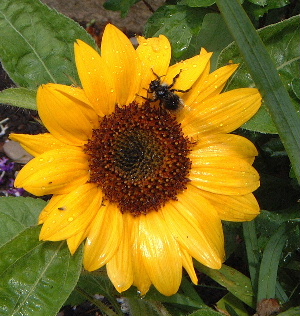
A prime example is the beautiful symmetry offered by a flower. Sunflowers have seedy centers with vibrant petals that radiate outward while the petals of an elegant rose gently fold over one another. This brings new meaning to the taking time to smell the flowers! There are many things in nature to enjoy when one pauses long enough to explore it.
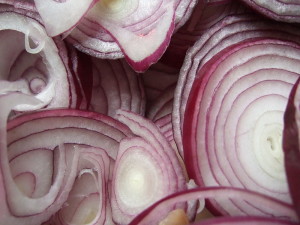
Vegetables are another great example! Sure, you may not relish the thought of slicing an onion but if you take a moment to enjoy the endless supply of circles it offers, you may find yourself cooking with them more often. Other natural mandalas can be observed in brussel sprouts, lettuce and tomatoes. Have you ever taken the time to examine an orange as you peel it? What about a kiwi or a grapefruit? They all offer mandalas.
Want to observe some truly remarkable natural mandalas? Take a stroll through a forest! Tree trunks of any size and every age radiate outward from the center to symbolize the tree’s life cycle. Observe a few pine cones that have fallen on the forest’s floor, notice how the layers flow perfectly from one to another? Turn over a simple wild mushroom and enjoy the mandala that is created around the stem.
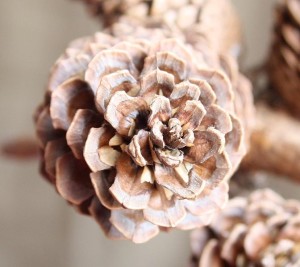
Pratheep P S, www.pratheep.com
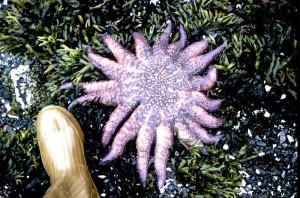
A large variety of wildlife and sea life offer exceptional examples of mandalas in nature too. The intoxicating design of zebras and tigers are easy examples that most people would recognize but jellyfish, starfish and octopus are great ones as well. A fantastic example of sacred geometry can be seen looking at a killdeer’s eggs as they are often arranged in the nest with the smaller end positioned toward the center.
Nearly everywhere you look around the planet, you are presented with endless possibilities of natural mandalas. There are a never-ending supply of landscapes that capture mandalic geometry, offering energy and spirit. Grand Prismatic Spring boasts eye-catching colors, the Olympic Peninsula houses gorgeous rock formations and a three-dimensional mandala is granted when you explore the Tufa Towers found in the Mono Lake of California.
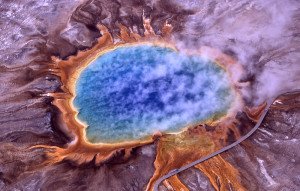
Grand Prismatic Spring
If you take the time to enjoy every part of nature, you will realize that mandalas are offered as gifts literally all around you. Each one provides its own journey that can help provide a quite meditative moment, allowing you to become one with the planet that offers you such captivating pieces of art. When you do recognize a mandala, you can then use it on your journey to find your center.
Article by Epouna
www.meaningofmandalas.com
Images from Wikimedia Commons
——————————————————————————————————–
I look forward to your thoughts and comments!
Be sure to Subscribe to this blog either by RSS or Email via the forms on the top right column of the page.
Like this:
Like Loading...
by atmara | Aug 1, 2011 | Art, Mandala Monday, Mandalas
The mandala can symbolize a variety of things including a sacred circle, the creation of a journey and it can even be used for healing, depending on the user. Mandala is the Sanskrit word for circle, it not only introduces you to your personal life’s circle but that of the universe as well. The great mandala can be found in various cultures, just as tribes throughout the planet make use of Native American mandalas in their own rituals.
While you may assume that the Tibetan mandala was the first variety ever created, the mandala from the Shaman in Native American culture is far more ancient. The center is the circle’s healing power while the four points of the circle are said to represent direction and form the sacred hoop. The Native American medicine wheel provides a good example of this.
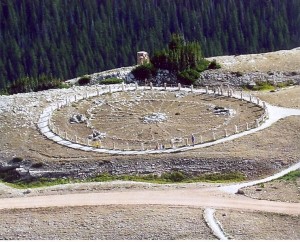
The medicine wheel offers a link to the mind, just as any other type of mandala does. There are left, right, front, center and rear ?lobes? that act as sections as if corresponding to a map of the human brain. Each point on the medicine wheel and the great mandala correspond with specific points in the mind to provide senses of sacredness, belonging, hope and strength.
The Native American mandala is often referred to as Nagual or Tonal, the Circle of Existence for good reason. The center is meant to house the user’s superconscious mind while the outer circle houses the conscious, also known as the surface mind. This is followed by four additional circles which must be viewed before the center is reached. These four circles include unconscious (auto drive), subconscious (magical), subjective (databank) and editor and censor. It is all of these elements in your surface mind that handles your daily experiences.
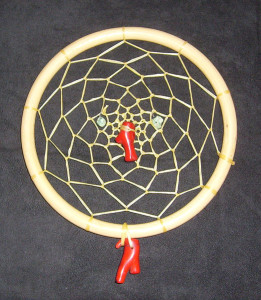
You may be familiar with the dream catcher, a very popular form of Native American mandalas. These were originally created by the Ojibwa Tribe to ward off nightmares of their children by hanging them over their beds. The web would entangle the bad dreams throughout the night which would disappear before daylight. Just as the Native American mandala has four directional points, so can the dream catcher.
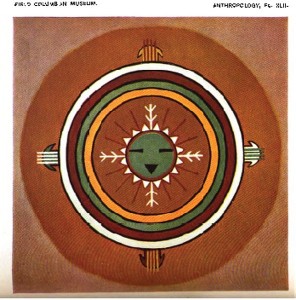
Sand paintings are another form of Native American mandalas. Constructed with precision, this free-form variety draws the user into its center. However, perfection is vital, if any flaws exist, the mandala can no longer be used. Once sand paintings have been appreciated, it is tradition that they are washed away in a body of water.
It is suggested that the dance shield associated with the Plains tribe’s is the ancestor to the Native American mandala. The dance shield has always been a sacred instrument used for protection, long life, survival and spiritual blessings.
The Circle of Life and Mother Earth are regarded with the highest level of respect by Native Americans, similar to many other cultures. The mandala can provide a clearness of the spirit when used in meditation as the center circle is focused on to help complete one’s journey
Article by Epouna
www.meaningofmandalas.com
Images from Wikimedia Commons
——————————————————————————————————–
I look forward to your thoughts and comments!
Be sure to Subscribe to this blog either by RSS or Email via the forms on the top right column of the page.
Like this:
Like Loading...