by atmara | Apr 2, 2012 | Art, Mandala Coloring, Mandala Monday, Mandalas
by Susan J. Elliott
I recommend coloring mandalas as a way of combatting obsession and anxiety. I recommended this originally, to friends, long before I was a therapist. I did so because coloring a mandala with colored pencils helped my own anxiety very early on in my own process. I still have it. One of these days I will post it. I don’t know exactly where I got it from. I went to so many different groups early on that I think that one of the groups did creative things while sitting around a table talking. I remember coloring this mandala and I remember learning to crochet. Both in the same group. I remember both being incredibly calming.
I didn’t know what a mandala was called and did not know that some cultures that use them do so for the healing that they provide. I did not know any of that. I found that out later when I was working with clients and thought back on some of the things that healed me. I researched what I had done and don’t even know how I found the answer, but I did. So the recommendation is there, as is most of my recommendations, through personal experience with myself, clients and academia. It’s not a random recommendation at all.
While in graduate school I read Adam Phillips and immediately signed onto his notion that boredom gives rise to creativity. I allowed my own kids to be bored, despite their wails, and they would always find a new and different way to make a game or do something new. Their television was restricted and we didn’t have cable and of course they weren’t surfing the internet or have cell phones. I distinctly remember them being bored and later playing outside together after making up a new game. Sometimes when I ride through the suburbs or even the city, I wonder where all the kids are and why they don’t play together. Oh yeah, they’re surfing the internet or playing a video game or have to be taken for a “play date” by Mom. No just running outside to play.
When I was a kid I wandered around the city. Took buses. Took subways. Observed things. I am fairly certain that without this alone time, where no one could reach me, I would have gone crazy. When I came home I would go to my room and draw. When I was little little I would draw people and have conversations between them. That gave rise to writing when I could put words and sentences together. But many times I would go back to my “people” and have them “talk” to each other. I went through reams and reams of paper. My father worked for Eastman Kodak and would bring me reams of paper. Although people now have reams in their homes, no one did then. I had stacks of paper and I would draw every day. I’m not artistic and my people were very basic, but it did give way to my writing. And that saved my life.
Not only does art, whether it be primitive stick people or coloring mandalas or painting something beautiful, help calm and soothe but it expresses feelings. Writing expresses feelings. Journal writing, fiction writing, song writing. Modeling clay, scrapbooking, photography, crocheting, knitting, working with your hands…it helps in many ways. If you play an instrument or want to learn, that helps. So much is out there to be explored. What do you want to do? Do it.
Boredom gives rise to creativity and creativity soothes and heals. The act of doing something with your hands, or of letting your mind just wander…or be bored…is to allow your portals to open up to new worlds and possibilities.
I lecture people on unplugging and of making their children unplug and letting their kids be bored. I know it’s hard. I’ve said to my son that his 18 month old does not need to watch a DVD on a car ride. I’ve told my other son that 5 year old boys don’t need those shopping carts with the cars on them. It is, many times, easier to do that than to allow the kid to just sit and be or to allow their fussiness that kicks in before the creative process.
I try not to lecture on it but when you know so much and know that allowing kids to be disgruntled and bored sometimes is a GOOD thing, you tend to lecture (esp at your own children) about it. Learning to sit and be even if you are whining and fussy at first, is a skill everyone needs to know. Waiting to wait in a line is something everyone needs to learn. See how easily you do it without looking at your phone. Can’t do it? Time to learn. Time to just stand there and watch what is going on inside of you and outside of you. Is it uncomfortable? Learn to live with it. It goes away. If you don’t learn to just stand and be or sit and be, everything else is going to be hard.
For kids, learning to sit and be or stand and is a good tool for later on. Self-discipline needs to be learned but it has to be taught first. “I don’t need to be entertained every second.” is a great lesson for kids. Not only that but if something OUTSIDE you is always stimulating you, then you are never going to discover what is IN you that is creative and wants to come out.
But more importantly, as adults we need to do these things. We need to stand and be bored. Observe. Inside and out. Sit and be bored. Then we need to find things to express ourselves. Writing, art, photography, knitting, woodworking etc. We need to actively pursue doodling when we’re bored instead of clicking on our cell phone. We need to resist the urge to pull the device out and start reading or texting or whatever.
The very act of putting pen to paper, colored pencil to paper, paint brush to canvas, needle to yarn, saw to wood is to invite the creative juices to flow. And the creative juices are healing. Creativity gives rise to healing. Art and writing and expressions of self are healing.
When I discovered the calming power of a mandela, I did not know it would calm me. I did not know what a mandela was. I did not know the science behind the very act of coloring, of expressing myself, no matter how trite it seemed to me.
As I’ve said on the blog many times, I had enough material for 3 books when I wrote the book. I’ve included the best of the best. Of what works and why.
I didn’t throw in “Oh, color a mandala” to patronize my readers or to give them busy work. I wrote it because it heals.
That doesn’t mean you have to do that. You can paint, draw, knit, woodwork but move those hands. Doodle on a pad (yes, doodling is therapeutic).
As you take time for yourself (and you MUST every single day) and take unplugged time for yourself (and you MUST every single day) don’t forget that nature abhors a vacuumn. You can’t just take something out. You have to put something in and that something is something creative.
Take 20 minutes a day and devote it to whatever you want to do to be more creative. Take photos, write a story, plunk the guitar strings, color a page, paint something. Do it without background noise or to stop and check email.
Then extend it to 30 minutes, 45…an hour.
I didn’t make up the fact that this is all very healing. First I did it, then I learned the science behind it. And that science is something that some cultures (Native American/Eastern cultures) already knew. That just the act of making something nice is healing. I am not an artist and yet I’ve painted two very nice paintings that I like a lot. And the second one isn’t even much of anything but I used short feathery strokes in about 50 shades of blue over and over again to create a painting that is pretty cool. I don’t know if it has an ounce of artist integrity but I know I liked doing it and I like looking at it now.
If you feel like something is lacking in your recovery plan, perhaps it’s a creative something. Think about what you want to do and do it. Or try it. And if it’s not that, do something else. But put some creativity in each day.
This article, Creativity and Healing, is syndicated from http://www.gettingpastyourbreakup.com and is reposted here with permission.

———————————————————————————————————
For free mandala images to color see my article: 10 Links to Free Mandala Coloring Pages
———————————————————————————————————
I look forward to your thoughts and comments!
Be sure to Subscribe to this blog either by RSS or Email via the forms on the top right column of the page.
by atmara | Mar 26, 2012 | Art, Creativity, Mandala Monday, Mandalas

By Paul Epstein, Bay Nature
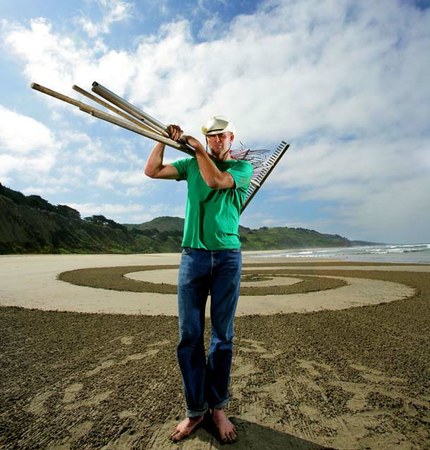
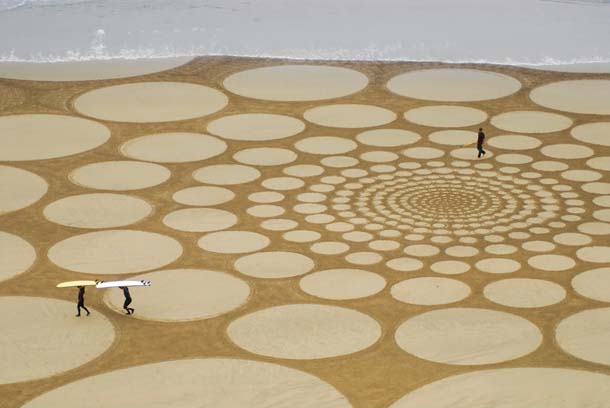
Now you see it. Now you don’t. Jim Denevan creates art — very large art — out of the most ephemeral media: patterns in sand which will wash away with the tide, tracings in the earth that will disappear with the first rain, etchings upon icy lakes that must melt with the coming of spring.
Beach aficionados know him as “that surfer dude” or “the guy on Ocean Beach.” Also a chef and an organic farmer, he is one of the founders of Outstanding in the Field, which aims to reconnect diners with the source of their food.
He has been compared to several artists. Like Christo, whose “Running Fence” transected Marin and Sonoma counties in the early and mid-1970s, and whose “Umbrellas” pocked hillsides and rice paddies on two continents in the mid-1980s and early 1990s, Denevan’s work is of enormous scale, and plays in, on and among natural features. Like Andrew Goldworthy, his work is composed entirely of natural materials patterned in striking geometric shapes. Others have likened his work to the sand mandalas of Tibetan Monks, to “alien” crop circles and to graffiti.
BAY NATURE:You’re from Santa Cruz, a community that is largely oriented around its beaches. How do you think your hometown has affected your outlook on art and on nature?
DENEVAN: The ocean, of course, is constantly changing, and the conditions of the waves and the wind and the weather. I think of nature as something that is changeable from season to season.
I grew up in San Jose. There were a lot of suburban developments, but I grew up next to
the Guadalupe River. When I was a kid there was practically no one down there checking things out. So I would make little constructions in nature, doing things with the water, and little dams, and coming back every season, the dams were destroyed in the winter. That’s the origin of my interest in imposing things on nature.
BN: The work that you do is made exclusively of natural media, mostly sand, eah and snow. How does this affect the process and the outcome of your work?
DENEVAN: It’s just as fascinating at the time of its destruction as the other aspects of making it and composing the work. At the beach, the tide is pretty regular. But I have done things where there’s also weather, a forecast for rain. In its disintegration, it’s interesting. A sand drawing on the beach when it’s half-destroyed is interesting.
I can see that change happen more quickly, in terms of a day or a week. That includes our lives. We go from being adolescents to young adults to middle aged through the human life span and a work of art has a birth and an existence and a death.
BN: What is the intention of your arthttp://www.baycitizen.org/partners/bay-nature/?
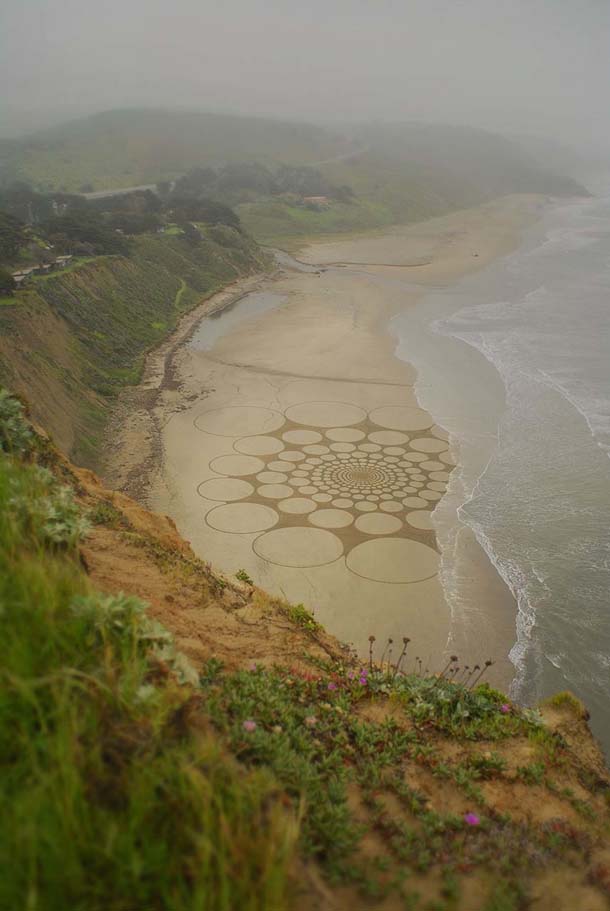
DENEVAN:A few different things: Recently I did a drawing at Ocean Beach [in San Francisco].
There’s an aspect of the art, especially when it’s done in a public area, that people can visit, they can compose themselves within the artwork. The artwork will have some relation to the size of a person’s body. And the compositional elements provide a path by which they can explore the relationship of their body to the composition. Drawing in the sand is very human, it’s gentle and it’s grand at the same time.I went out two days ago for the first time in a long time and it was very, very soothing to me, very peaceful. And also it’s physically challenging to walk for a period of hours, and to use my strength to push the sand. It’s fulfilling to complete something. It’s difficult.
I have been doing this for almost 18 years now, and I have kind mixed feelings about it now. I have made a substantial amount of money in the last year doing commissions in different places in the world. But generally there’s no money to be made; there’s no photograph to be sold.
BN: When people, dogs, and frisbees come through, is that annoying?
DENEVAN: I consider the people something like the waves in the erosion of the drawing, meaning that I appreciate their interest and their comments, but can’t control what they’re going to be doing at the beach, with digging holes or who knows what. And I never stop anyone from playing volleyball.
BN: Of all the different art that you have done in the Bay Area, which one has been the most meaningful to you, and why?
DENEVAN: I have to say the drawings I’ve done on Ocean Beach. I really appreciate when people have come into the artwork and experienced it for themselves, and the comments that they make, and the appreciation they have for what I’m doing. It’s a little overwhelming. It’s probably why I don’t do it all that much.
BN: Most people are very enthusiastic about your work. Some have compared your work, perhaps critically, to either Christo or Goldworthy; or alien crop circles or Buddhist sand mandalas. What do you make of those comparisons?
DENEVAN: Well, the first thing that comes to mind is that it’s a similar impulse that I have to those that you listed. I think Christo and Goldsworthy, and certainly Australian Aboriginals or Tibetan Monks, are concerned with similar questions. It’s inevitable that expression is going to evolve that’s going to be personal.
BN: If you could have access to any site in the Bay Area, and do any kind of composition there, suspending the usual laws, permitting rules and social norms, where would you choose and what would you do?
DENEVAN: Something that I’ve been thinking about for a while is the salt ponds in the South Bay. When you fly in, you see the various colors that exist. What I would do is have brilliantly different colored circles, using the different times of the salt production. I’ve done a little research into that and actually, I’ve been meaning to go down there and walk around and get a feel for that whole area. I don’t think anyone would argue against that. I think it would be fun and interesting and very beautiful, with the bright colors.
BN: What are the challenges you face in your work?
DENEVAN: I’ve had people that have been drinking alcohol on the beach and they come up to me and try to ask me questions when I’m trying to concentrate.
And then I’ll go up to a high spot, and I’ll see the mark of where the conversation was, where I lost my concentration. And you can see where the drawing went off course, which I think is kind of fascinating and I can’t get mad. It would ruin it.
BN: How does your work affect the viewer’s perceptions of the local environment
DENEVAN: It touches them because it brings them closer to something I think they already know, but maybe don’t see so much in their daily life, that things – whether they’re culture or nature – are transitory. They will be transforming to something else, and therefore, personally when people are experiencing the artwork, they are recognizing their temporality, and that blends into the perception of – and the experience of – the day, and the experience of the specificity of one day, one day in one life.
BN: Is there anything else that you would like to say?
DENEVAN: I’m just excited and fascinated with the world and nature and how it is that I’m alive. I feel that when somebody walks into a sand drawing, we’re all in the same place. I mean maybe physically, walking into the sand drawing, but also in the sense that we’re human, that we can be sick, that we can die, that we can be injured; we’re all part of the physical phenomena of the world, in a temporal sense.
By Paul Epstein, Bay Nature


———————————————————————————————————
I look forward to your thoughts and comments!
Be sure to Subscribe to this blog either by RSS or Email via the forms on the top right column of the page.