by atmara | Feb 6, 2012 | Art, Mandala Monday, Mandalas
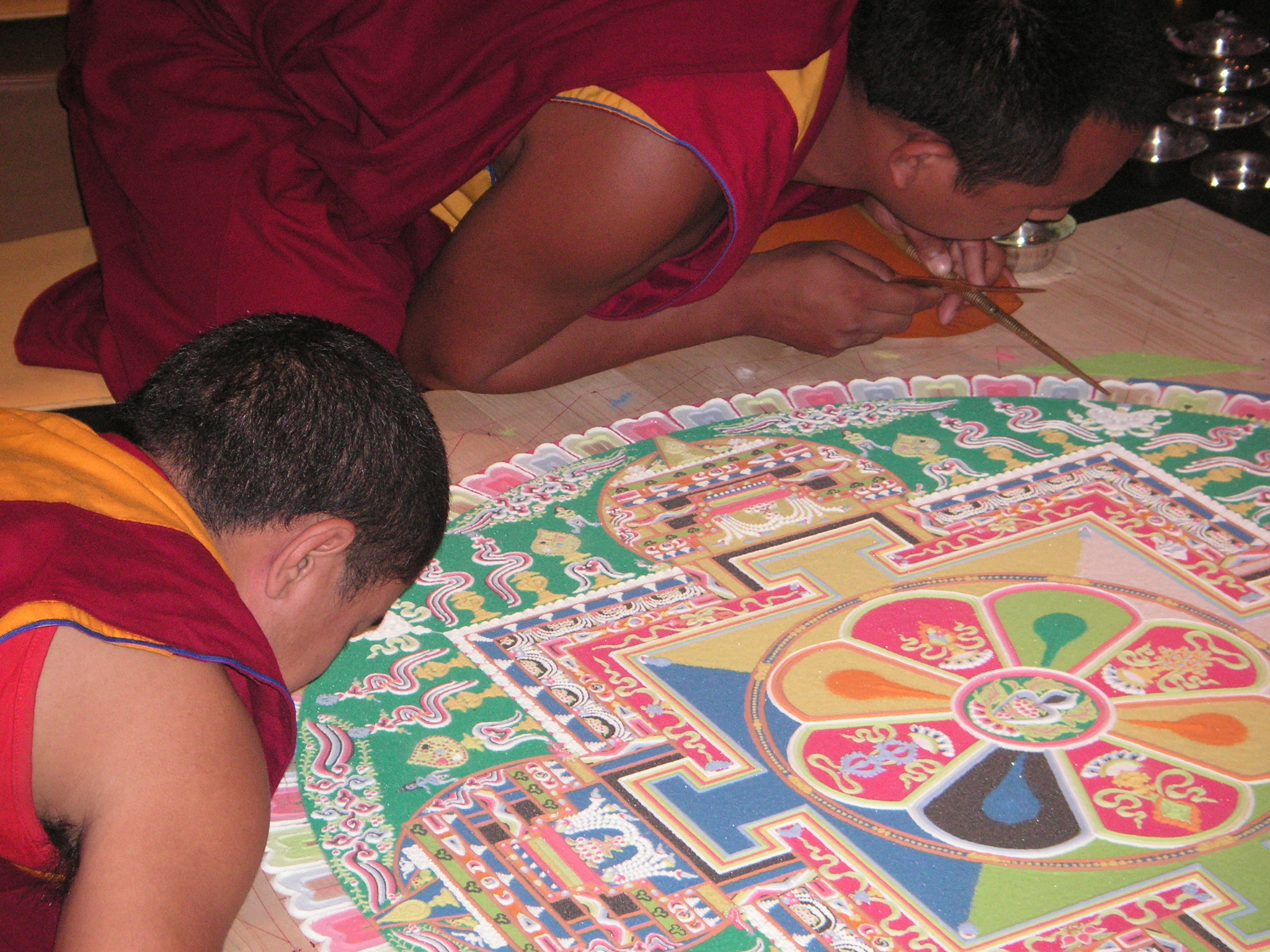
Can you imagine spending several hours, days, or even weeks on a work of art, and then destroying it? The idea of creating something only to wipe it out when you’re finished is illogical and counterproductive to many people in the Western world. But in some cultures, this is a common procedure, and one that serves a deeper purpose than meets the eye.
Sand painting is the perfect example of ephemeral art – that is, art that is meant to be temporary. To create a sand painting, colored sand is poured carefully into predetermined patterns. Sand painting is a common practice amongst many diverse indigenous cultures from around the world, including the Australian Aborigines, the Native Americans, and the Tibetans, as shown above. Tibetan sand painting is a perfect example of making art that values ‘process’ over ‘product’. In the Western world, it’s often the opposite – artists labor over paintings for the purpose of selling them for profit. The art, even though it may be a labor of love, is also a ‘product’. The ‘process’ of making art is treated as a means to an end. In Tibetan sand painting, the process of creating the intricate sand mandalas is far more important than the final product. Tibetan sand paintings are created by Buddhist monks for ritual purposes related to healing and blessing. As the sand mandalas are painstakingly created, viewers are often allowed to watch and admire the precision of the artists and the beauty of the design. Destroying the finished sand mandalas contains a ritual purpose as well; it is a lesson on impermanence. Perhaps artists from Western cultures can benefit from some of these ideas by paying closer attention to the process of making art, rather than worrying about how the final product will turn out.
Article Source: http://www.articlesbase.com/art-articles/the-art-of-tibetan-sand-painting-4297166.html
About the Author
Mark Feldman is President of SegTech, a company devoted to a wonderful Image Segmentation technology called Segmation. Segmation – The Art of Pieceful Imaging
Paint-by-numbers meets modern technology in SegPlay® PC, a computerized paint-by-numbers program for Windows 7, Vista, XP and 2000. With twenty built in images and powerful features for artsy types and casual gamers, SegPlay® PC is simple to use with infinite variety.
There are also hundreds of available add-on patterns for SegPlay® PC organized in over 100 categories from famous historical artists to colorful illustrations to natural photographic scenery.
Play online for free!
Visit our website: http://www.segmation.com
Read our blog: http://segmation.wordpress.com
Join us on Facebook: http://www.facebook.com/segmation
——————————————————————————————————–
I look forward to your thoughts and comments!
Be sure to Subscribe to this blog either by RSS or Email via the forms on the top right column of the page.
by atmara | Jan 23, 2012 | Art, Inspiration, Mandala Monday, Mandalas
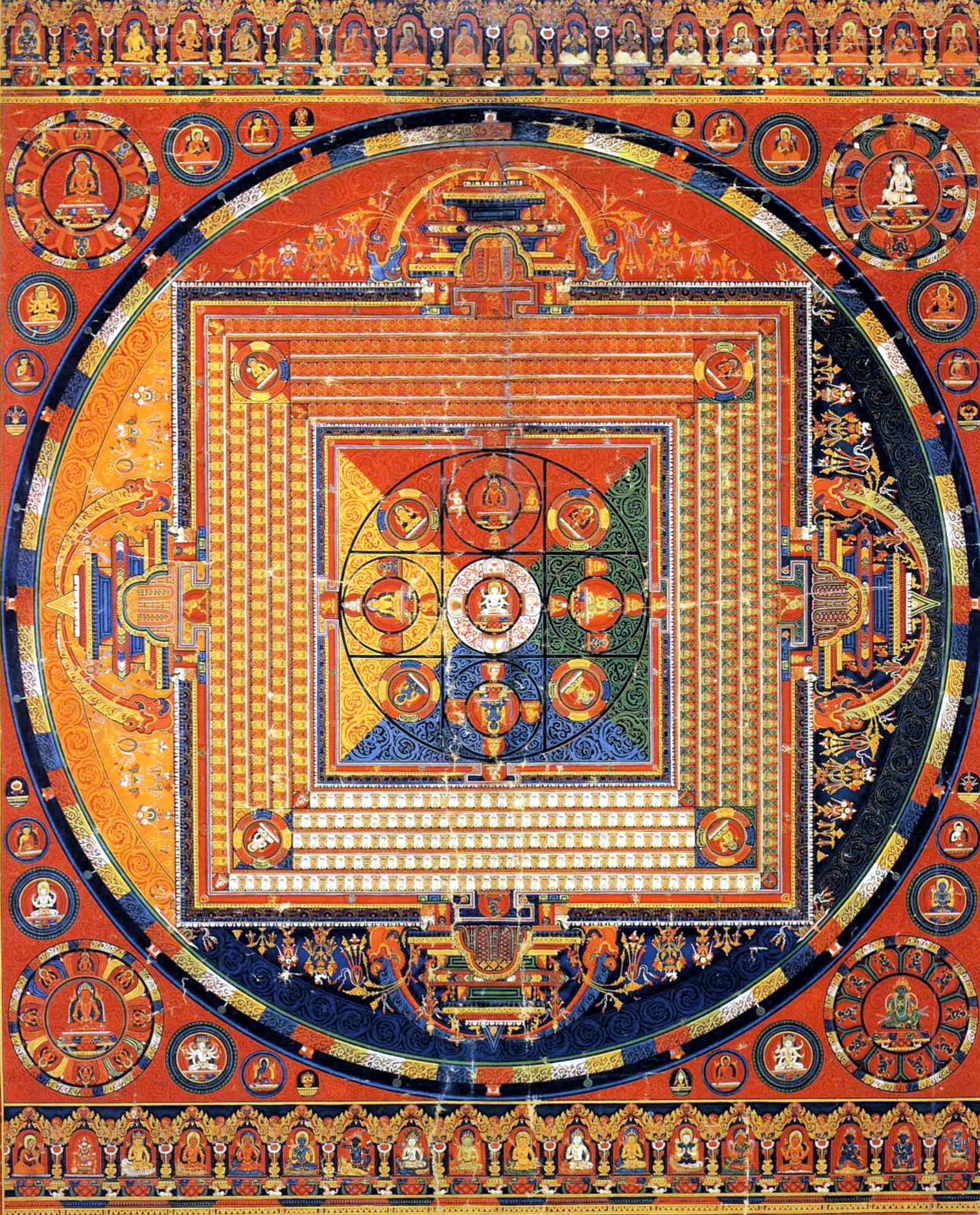
“Mandala of Vajradhatu” by Anonymous Tibetan artist – scan of painting. Licensed under Public domain via Wikimedia Commons.
Author: Don Reid
Neo, in “The Matrix” movie, needed his brain to be plugged into a supercomputer, so he could learn martial arts in minutes, and Trinity in the nick of time, could fly a chopper so they could get away from the “agents”. Using encoded mandalas is the closest working model to this science fiction, that proves that old adage, there is nothing new under the sun.
Mandalas have been used as far back in time as we can remember. Most people today, when visiting ancient ruins, like pyramids, can see images, of geometric patterns and designs in the decoration, even in early Christian Churches. Or are they merely decoration?
The first time I ever seen a symbol like a mandala, it was a pentagram, and I was scared to death of it because of course it was in a horror movie and I was a small child at that time. It wasn’t until much later, that I learned in geometry, that Pythagoras, of the famous Pythagorean theorem, was also a numerologist. This numerology is all about the numbers and subtle meanings that had nothing to do with mathematical formulas, i.e. [a squared + b squared = c squared] and I did confuse me. Why wasn’t this taught as well? If his theorems worked, why wasn’t this other aspect of his contributions taught in High School math?
From Wickipedia
“In various spiritual traditions, mandalas may be employed for focusing attention of aspirants and adepts, as a spiritual teaching tool, for establishing a sacred , and as an aid to meditation and trance induction. According to David Fontana, its symbolic nature can help one “to access progressively deeper levels of the unconscious, ultimately assisting the meditator to experience a mystical sense of oneness with the ultimate unity from which the cosmos in all its manifold forms arises.” The psychoanalyst Carl Jung saw the mandala as “a representation of the unconscious self,”[ and believed his paintings of mandalas enabled him to identify emotional disorders and work towards wholeness in personality.
In common use, mandala has become a generic term for any plan, chart or geometric pattern that represents the cosmos metaphysically or symbolically, a microcosm of the Universe from the human perspective”
Take away all the esoteric stuff, and you still don’t have much you can use here. Most people are spiritual but not inclined to seek out the cosmos or metaphysics. However, something of value is here if we take the time to apply what could be a new beginning, and a transformation of human learning and understanding.
Do you remember that scene in “The Matrix” movie? when Neo learned martial arts in an instant… think about it… what would that application look like in real life?
Brain Mirror neurons, a recent discovery, are said to operate and/or fire signals through the brain.. whether the person is completing an activity or simply watching the activity. This has serious implications, to what we call learning and what is possible in regards to Matrix Style Learning (training).
Of course some variant of this is possible otherwise I wouldn’t be writing this article.
Four years ago, I was amazed at my own brain mirror neurons being trained a sequence of Chi Gung movements and instantly getting the benefit of that training.
This training would otherwise taken years of practice. Not only that, the use of Mandalas and sacred geometry was explained to me in a way I never heard before. Brain mirror neurons can actually understand like some type of computer Operating System (OS), sacred geometric shapes, images and patterns and by looking at these images… hmmm just like the ancient spiritual practicioners, suggested, esoteric or not, benefits can be derived.
Fast forward to Dec 16th, the day I launched the I Chi Power App on Itunes (www.i-chipower.com) I codesigned an app for Iphone that actually works with brain mirror neurons providing an instant benefit. I called this the I Chi Power App, because you the user get to experience what I had experienced over the years instantaneously in this App. Check out the You Tube demo to see first hand one of the benefits of this app and you might find yourself on a journey to unlocking your true potential.
Article Source: http://www.articlesbase.com/meditation-articles/the-science-and-secrets-of-mandalas-3981809.html
About the Author
Don Reid is an avid reader, sci fi junkie, and former teenage comic book junkie. Professionally he worked as a Stock Broker, and currently has spent the last few years, in small business venture capital. He has studied Chi Gung, Tai Chi and several disciplines in the martial arts. Currently a student of Shaolin ShSD based in San Francisco, he has been exposed to systems that have lead him to launch Quantum Visuals Unlimited Inc, to help unlock the human potential using these amazing training tools.
——————————————————————————————————–
I look forward to your thoughts and comments!
Be sure to Subscribe to this blog either by RSS or Email via the forms on the top right column of the page.
by atmara | Jan 16, 2012 | Art, Mandala Monday, Mandalas, Sacred Geometry
What is a talisman?
The word “Talisman,” derived from the Greek verb “teleo,” means, primarily, to accomplish, or bring into effect. The Talisman is an object marked with magic signs and is believed to confer on its bearer supernatural powers or protection. Virtually every religion in human history has offered as adherents small decorative objects which purpose is to do anything ranging between healing, protection or success.
Talismans and sacred geometry
Very often the talismans symbols are taken out of sacred geometry. The term “sacred geometry” is used by archaeologists, anthropologists, and geometricians to encompass the religious, philosophical and spiritual beliefs that have sprung up around. It is a term covering Pythagorean geometry and neo-Platonic geometry. Sacred geometry is often referred to as a language of G-d. Sacred geometry symbols are a means of bringing subtle, inner realities to a focus in outward expression. Within the fundamental unity of consciousness, certain symbols, such as the lotus lifting itself in purity above the muddy water, possess universal relevance and power.
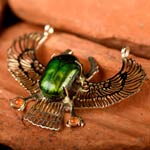
Ancient Egyptian Talismans Scarab beetle
The young scarab beetles emerged spontaneously from the burrow they were born in. Therefore they were worshipped as “Khepera”, which means “the one who came forth”. The scarab-beetle god Khepera was believed to push the setting sun along the sky in the same manner as the beetle with his ball of dung. In many artifacts, the scarab is depicted pushing the sun along its course in the sky.
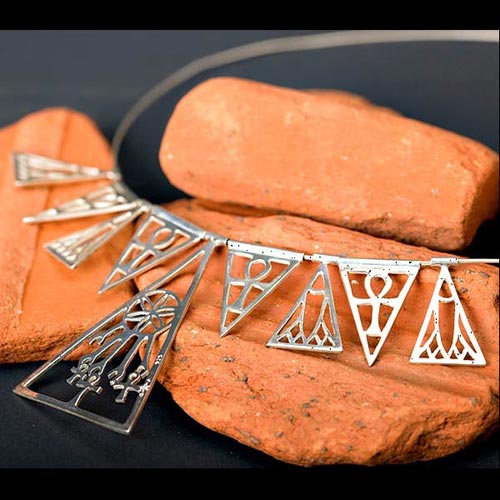
Ankh
The Ankh is a symbolic representation of both Physical and Eternal life. It is known as the original cross, which is a powerful symbol that was first created in Ancient Egypt. Ankh is typically associated with material things such as water, air, sun, as well as with the Gods, who are frequently pictured carrying an Ankh.
Heart
In Egyptian history, the heart replaced the heart which was removed during mummification. Sometimes assimilated to the Bennu, “Soul of Râ”, it brings the protection of both Osiris and Râ.
Other Egyptian talismans Buckle or Knot of Isis, Djed, Ba, Two Fingers and Udjat or Eye of Horus.
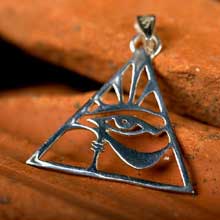
Christian Talismans
The cross: The cross of Christianity was a symbol of the faith. It was previously considered a pagan symbol, with several early church fathers objecting to its use. The cross represents Christ’s victory over death and sin, since it is believed that through His death he conquered death itself.
Fish: The fish’s first known use as a Christian religious symbol was sometime within the first three centuries AD. Christians began using the Greek word for “fish” as an acronym for “Jesus Christ God’s Son, Savior”. Followers of Christianity were called Pisciculi; the root of this Latin word is “fish”.
Jewish and Kabbalah Talismans
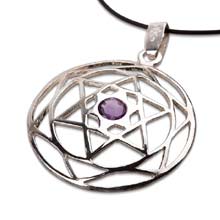
Star of David: The name David in ancient Hebrew (during the time of King David) is made up of three letters “Dalet”, “Vav” and “Dalet”. The letter Dalet in ancient Hebrew is actually a triangle. King David used the six pointed star as his signature (the two triangles of his name). The middle letter “Vav” means six – The six pointed star. The six-points symbolize that God rules over the universe and protects us from all six directions: North, South, East, West, Up and Down. King David used this symbol in the battlefield on his shield as an omen from God.
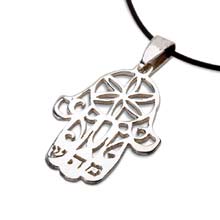
Hamsa: The Hamsa is known as the hand of Miriam or Hamesh hand. The Hamsa serves as an ancient talismanic way of averting the evil eye and providing a “protecting hand” or “Hand of God”. The Hamsa often appears in stylized form, as a hand with three fingers raised, and sometimes with two thumbs arranged symmetrically.
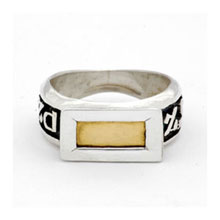
Five metals ring: According to the ancient kabalistic text, the secret of the five metals ring success is that at the specific time of the creation of the ring with these five metals, Jupiter’s influence is summoned forth. Jupiter is the star of development and expansion, and success is at it’s strongest at the specific time of the ring’s creation. The layer on the top of the five metals ring is pure gold. Below it there is a layer of lead and tin, and the last layer is copper, while the ring itself is made out of silver.
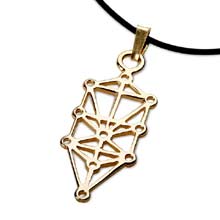
Tree of life: The Tree of Life is one of the most familiar of the Sacred Geometry Symbols. The structure of the Tree of Life is connected to the sacred teachings of the Jewish Kabbalah. The Tree of Life is explained in Sefer Yetzira (“Book of Creation”). The book explains the creation as a process involving the 10 divine numbers (sefirot) of God the Creator and the 22 letters of the Hebrew alphabet. The 10 sefirot together with the 22 letters constitute the “32 paths of secret wisdom”.
Buddhist Talismans
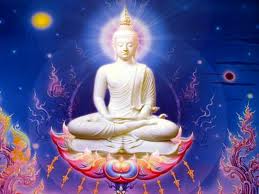
Buddha: Buddha images provide a reassuring reminder of the basic tenets of Buddhist religion. Just as Buddhist religion is practiced in many different ways, the Buddhist image also serves a wide variety of ritual purposes and has different meanings for different people. Buddha can be invested with a huge amount of information, meaning and implication; they evolve and they are given life. The Buddha image cast in the human form gives it a value presented as calm, still and serene.
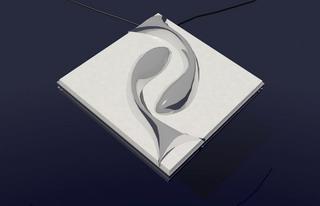
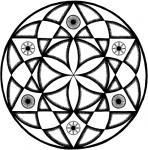
Mandalas: The Tibetans create their beautiful Mandalas from colored sand and if you’ll take a metal plate and cover it with sand and make it vibrate with different sounds, you will be able to see different structures that are formed in the sand, that are very similar to the sand Mandalas. In the end, after a few weeks when the Mandalas is finished, they simply wipe the sand off Mandalas to show the non-attachment to the illusion of the external, and also to show the constant change and the process of life and death that takes place in the external world of illusion.
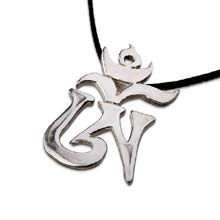
OM: Om (?) is the most sacred syllable in Hinduism, first coming to light in the Vedic Tradition. The syllable is sometimes referred to as the “Udgitha” or “pranava mantra”. The symbol of Om contains three curves, one semicircle and a dot. The large lower curve symbolizes the waking state; the upper curve denotes deep sleep (or the unconscious) state, and the lower curve (which lies between deep sleep and the waking state) signifies the dream state.
Tibetan Knot: The Tibetan knot (Srivatsa or the endless knot) is one of the eight symbols of the Tibetan Buddhism. The Tibetan knot can stand for karmic consequences: pull here, something happens over there. It is an apt symbol for the Vajrayana methods: Often when we tug at one part of a knot while trying to loosen it, another part becomes tighter. You have to work with the knot to enable it to come undone. In its endless configuration, it evokes the cyclic nature of rebirth and also calls karmic connections to mind.
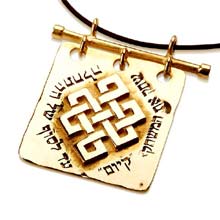
David related work – Talismans jewelry
Article source – Talismans
Written by David Weitzman – Ka Gold Jewelry artist
Images from Ka Gold Jewelry
——————————————————————————————————–
I look forward to your thoughts and comments!
Be sure to Subscribe to this blog either by RSS or Email via the forms on the top right column of the page.