
Mandala Monday – The Mandala Set by Sylvia Smelcer
A mandala set (or Dultson Kyilkhor in Tibetan) is a tool used by Buddhists, Hindus, and Jainists in their offering ceremonies. The mandala set represents the mind and body of the Buddha, and can grant practitioners great power. The Sanskrit word mandala means “circle”. Mandala sets are often used in the mandala offering ritual. In this ritual, the practitioner offers the universe to the gods. In modern times, a mandala set is also used simply for decoration because of its exquisite aesthetic qualities. The mandala set is made up of several different parts. The center of the mandala is a tall pillar representative of Mount Meru, which is a sacred Eastern mountain considered to be the center of all universes. Mount Meru is reputed to be 672,000 miles high, and has inspired the construction of many temples. Many believe that the solar system revolves around the mountain, but its exact location remains to be found. Mount Meru is described as having four sides, with each side having a different color, lapis lazuli, ruby, gold or crystal. The symbolic Mount Meru of the mandala set is crowned with an ornamental top.
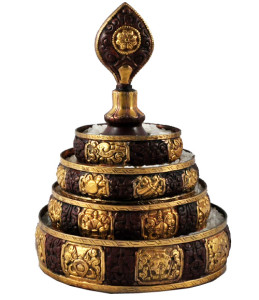
When one meditates upon a mandala set, they will utter prayers of sacrifice and offering. The practice is often begun by recitation of Vajrasattva’s hundred-syllable mantra while he wipes the base clean. Next, the practitioner might add a drop of water to the base, which symbolizes his compassion. Around the center post rests a set of three concentric circles, upon which offerings may be placed. The practitioner will place each ring while reciting corresponding prayers. One can visualize Mount Meru throughout their offering, or envision planet Earth as a veritable Mount Meru in the center of the universe. Each layer will then be filled with offerings. The offerings can be the same materials in each ring, or different for each one. Examples of common items offered are coins, beads, jewels, or rice. Others choose to offer more unique items, such as powdered flowers and herbs. It is suggested that one should offer items that the practitioner finds valuable, not what the recipient, or Buddha, finds valuable. The higher the value of the offerings, the higher degree of merit one will achieve. Also, the higher the quality of one’s visualizations during the meditation will bring about greater merit. Once the mandala set is filled, one may raise the entire piece over his or her head, symbolizing their willingness to sacrifice the entirety of existence in order to aid others in attaining enlightenment. Through this sacrifice, one will gain both wisdom and merit. At the end of practice, one should visualize benevolent deities transforming into a white light and entering the soul of the practitioner. The simpler preliminary practice called the Dudjom Tersar Ngondro uses only a mandala pan, filled with similar offerings cited above. The mandala set can be used in other capacities as well. One may make an offering to a spiritual teacher as a request for guidance, to present a solemn vow, for tantric empowerment, or as a symbol of gratitude at the close of a teaching or ceremony. Alternatively, those seeking to make an offering but do not have a mandala set available can form the mandala hand mudra, which can be commonly seen amongst Buddhist monks. The mandala hand mudra is fashioned by loosely entwining ones fingers together, while keeping ones palms open and facing upwards.
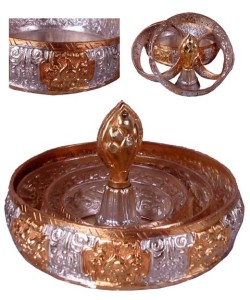
Mandala sets can be made of various metals such as copper, brass, silver, gold or lesser quality materials. As with most other religious items, mandala sets may be embossed or engraved with Sanskrit or Tibetan mantras and symbols. Mandala sets often bear the markings of the eight auspicious symbols. The three rings signify the Three Jewels of Refuge, namely the Buddha, the Dharma and the Sangha. It is recommended that one have their mandala purified every month, or at the very least on an annual basis.
Mandala offering sets are a staple in the lives of Buddhist followers. Mandala sets provide an important preparation for daily meditation. Practitioners require mandala sets to help them balance the outer world with their inner mind. Especially used in conjunction with other meditative tools, the mandala set can grant the illusive virtues of wisdom and merit to devotees.
The Mandala Set, and other items of interest in Tibetan Buddhism, such as Tibetan Singing Bowls, are of interest to Sylvia Smelcer, who is the owner of websites offering these items. They can be found at http://www.hinkyimport.com/
Images from http://www.hinkyimport.com/
——————————————————————————————————–
I look forward to your thoughts and comments!
Be sure to Subscribe to this blog either by RSS or Email via the forms on the top right column of the page.