by atmara | Sep 19, 2013 | Sustainability, TED Talks, Video

According to www.ted.com: “Desertification is a fancy word for land that is turning to desert,” begins Allan Savory in this quietly powerful talk. And it’s happening to about two-thirds of the world’s grasslands, accelerating climate change and causing traditional grazing societies to descend into social chaos. Savory has devoted his life to stopping it. He now believes — and his work so far shows — that a surprising factor can protect grasslands and even reclaim degraded land that was once desert.”
“Allan Savory works to promote holistic management in the grasslands of the world. In 1992, Savory and his wife, Jody Butterfield, formed the Africa Centre for Holistic Managementin Zimbabwe, a learning site for people all over Africa. In 2010, the Centre won the Buckminster Fuller Challenge for its work in reversing desertification. In that same year he and his wife, with others, founded the Savory Institute in Boulder, Colorado, to promote large-scale restoration of the world’s grasslands.”
Enjoy this very interesting talk.
For those of you not familiar with TED Talks here is a brief summery from www.ted.com:
“TED is a small nonprofit devoted to Ideas Worth Spreading. It started out (in 1984) as a conference bringing together people from three worlds: Technology, Entertainment, Design. Since then its scope has become ever broader. Along with two annual conferences — the TED Conference in Long Beach and Palm Springs each spring, and the TEDGlobal conference in Oxford UK each summer — TED includes the award-winning TEDTalks video site, the Open Translation Project and Open TV Project, the inspiring TED Fellows and TEDx programs, and the annual TED Prize”
——————————————————————————————————–
I look forward to your thoughts and comments!
Be sure to Subscribe to this blog either by RSS or Email via the forms on the top right column of the page.
by atmara | Sep 16, 2013 | Art, Mandala Monday, Mandalas
If you have ever wondered why every mandala that you see is round in shape, it is because the English word circle is translated from the Sanskrit word mandala. Although you may have been recently introduced to the term, it is certainly nothing new. In fact, the idea behind mandala was used in many religions, thousands of years ago, long before it began its rise in popularity in the Sanskrit world.
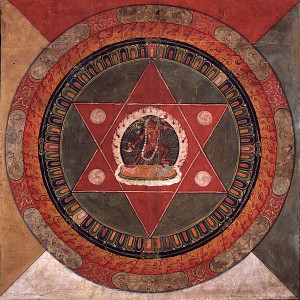
Painted 19th century Tibetan mandala of the Naropa tradition
The powerful circular form of the mandala is prevalent in Buddhist and Hindu religions. You will notice four gates in the shape of a T that extend from the center point in these pieces, showing the circle of unity. Vajrayana is a Tibetan branch of Buddhism that offer total enlightenment by creating their mandalas as sandpaintings. Of course, this is certainly not the only example of mandala used in religion.
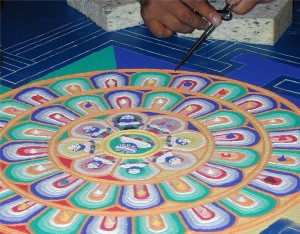
Tibetan monks making a temporary “Sand-Mandala”
in the City-Hall of Kitzbuehel in Austria.
The moji-mandala is a common form you will find in Nichiren Buddhism. It’s created as a wooden tablet or a hanging paper scroll. These not only hold inscriptions of Chinese characters but medieval Sanskrit as well to cover Buddha’s concepts, enlightenment and protective elements as well as other gods of Buddha. Nichiren religions worship this form of mandala, also referred to as Gohonzon.
Two and three-dimensional mandalas with geometric angles are used in meditation in Hindu rituals. Referred to as Yantras in this case, it is believed that the gods live within them. Therefore, each Yantras is unique to one god. Individuals who use Yantras for worship are able to seek the presence of these gods to ask for guidance.
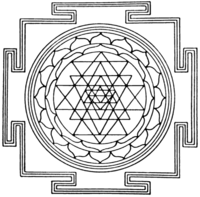 A diagramic drawing of the Sri Yantra, showing the outside square,
with four T shaped gates, and the central circle.
Those who practice the Christian religion may be familiar with mandala in the form of rosary, halos, Crown of Thorns, rosy cross, rose windows and Celtic crosses. These are all used by worshipers to feel closer to God.
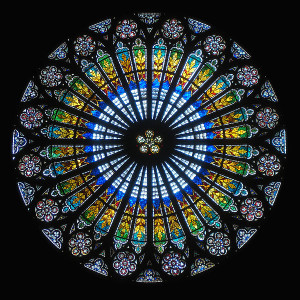 Interior of the rose at Strasbourg Cathedral.
For many centuries, the Bora Ring site has been used for initiation rituals by Australian natives. The girdle or circular belt worn by the acolytes is referred to as the Bora. Intricate stone arrangements such as Stonehenge offer a close relation to the mandala and Bora Ring. Creator-spirit Baiame is represented in ancient art and rock carvings as a mandalan figure.
You will find a collection of both inner and outer circles when viewing a mandala. These offer a different representation depending on which religious group is viewing the piece. Native-Americans have also used the mandala form in their culture. The inner mandala supports offerings pertaining to the body while the outer supports human senses.
You may or may not be familiar with labyrinths which are closely related to the mandala as they both take you on a circular journey toward the heart of the piece. Minotaur of ancient mythology was the inspiration behind the first labyrinth being built so that it could be held safely. The labyrinth’s center is viewed as being divine just as the mandala’s center offers enlightenment.

Labyrinth
The greatest of mandalas is the spiral or circle of life. Trusting in your beliefs will give you the truest meaning. These are the strong beliefs that send you on an inner journey as you observe and are surrounded by the outer world, just as the mandala began its journey in the Sanskrit world.
Article by Epouna
www.meaningofmandalas.com
Images from Wikimedia Commons
——————————————————————————————————–
I look forward to your thoughts and comments!
Be sure to Subscribe to this blog either by RSS or Email via the forms on the top right column of the page.
by atmara | Sep 12, 2013 | Oneness, Spiritual Awakening, TED Talks, Truth, Video
According to TEDxTalks: “Jeff Lieberman, an MIT-trained artist, scientist and engineer, makes a scientific argument for mystical experience. He asks us to challenge our perception of what we are, our relationship to the universe, and our relationship to one another. Our minds are “thought-generating machines.” What we would happen if we could turn off the machine? If we could transcend our individual experience of the world?”
I love it when science and spirituality converge. Enjoy!
For those of you not familiar with TED Talks here is a brief summery from www.ted.com:
“TED is a small nonprofit devoted to Ideas Worth Spreading. It started out (in 1984) as a conference bringing together people from three worlds: Technology, Entertainment, Design. Since then its scope has become ever broader. Along with two annual conferences — the TED Conference in Long Beach and Palm Springs each spring, and the TEDGlobal conference in Oxford UK each summer — TED includes the award-winning TEDTalks video site, the Open Translation Project and Open TV Project, the inspiring TED Fellows and TEDx programs, and the annual TED Prize”
“In the spirit of ideas worth spreading, TEDx is a program of local, self-organized events that bring people together to share a TED-like experience. At a TEDx event, TEDTalks video and live speakers combine to spark deep discussion and connection in a small group. These local, self-organized events are branded TEDx, where x = independently organized TED event. The TED Conference provides general guidance for the TEDx program, but individual TEDx events are self-organized.”
——————————————————————————————————–
I look forward to your thoughts and comments!
Be sure to Subscribe to this blog either by RSS or Email via the forms on the top right column of the page.