TED Talk Thursday – Peter Diamandis: Abundance is our future

For those of you not familiar with TED Talks here is a brief summery of them from www.ted.com:

“TED is a small nonprofit devoted to Ideas Worth Spreading. It started out (in 1984) as a conference bringing together people from three worlds: Technology, Entertainment, Design. Since then its scope has become ever broader. Along with two annual conferences — the TED Conference in Long Beach and Palm Springs each spring, and the TEDGlobal conference in Oxford UK each summer — TED includes the award-winning TEDTalks video site, the Open Translation Project and Open TV Project, the inspiring TED Fellows and TEDx programs, and the annual TED Prize”

According to ted.com:

“Onstage at TED2012, Peter Diamandis makes a case for optimism — that we’ll invent, innovate and create ways to solve the challenges that loom over us. ‘I’m not saying we don’t have our set of problems; we surely do. But ultimately, we knock them down’.”

“Peter Diamandis is the founder of the X Prize Foundation, a nonprofit whose mission is simply “to bring about radical breakthroughs for the benefit of humanity.” By offering a big cash prize for a specific accomplishment, the X Prize stimulates competition and excitement around some of the planet’s most important goals.”

Enjoy this uplifting talk.


——————————————————————————————————–

I look forward to your thoughts and comments!

Be sure to Subscribe to this blog either by RSS or Email via the forms on the top right column of the page.


Mandala Monday – Artist Uses Local Beaches as Enormous Canvases By Paul Epstein

By Paul Epstein, Bay Nature


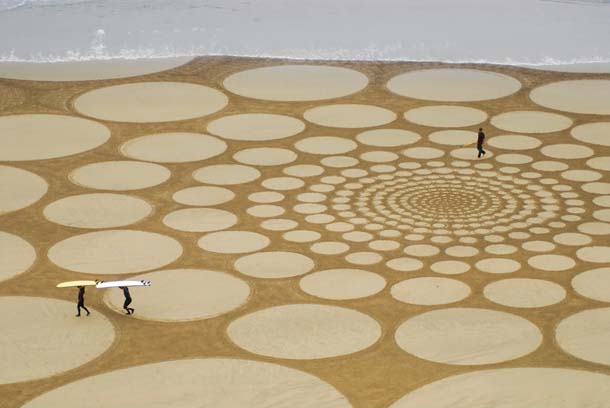
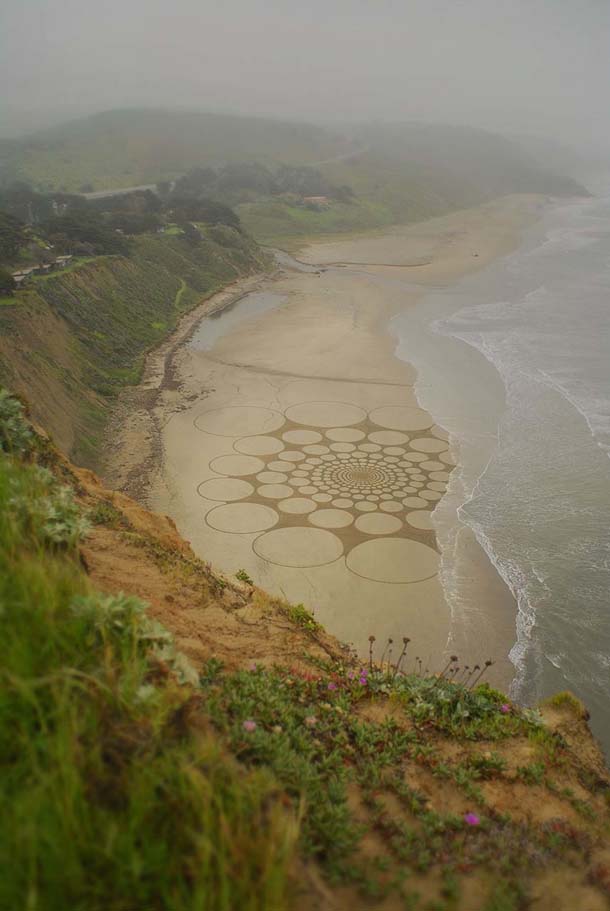
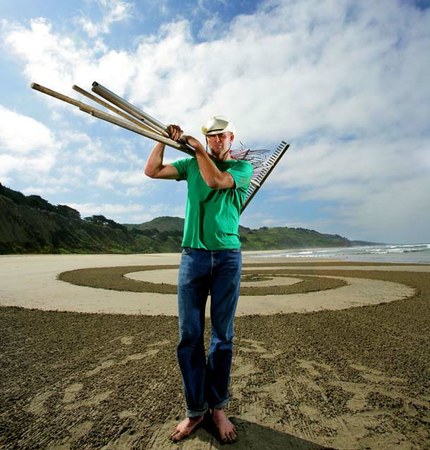
Now you see it. Now you don’t. Jim Denevan creates art — very large art — out of the most ephemeral media: patterns in sand which will wash away with the tide, tracings in the earth that will disappear with the first rain, etchings upon icy lakes that must melt with the coming of spring.

Beach aficionados know him as “that surfer dude” or “the guy on Ocean Beach.” Also a chef and an organic farmer, he is one of the founders of Outstanding in the Field, which aims to reconnect diners with the source of their food.

He has been compared to several artists. Like Christo, whose “Running Fence” transected Marin and Sonoma counties in the early and mid-1970s, and whose “Umbrellas” pocked hillsides and rice paddies on two continents in the mid-1980s and early 1990s, Denevan’s work is of enormous scale, and plays in, on and among natural features. Like Andrew Goldworthy, his work is composed entirely of natural materials patterned in striking geometric shapes. Others have likened his work to the sand mandalas of Tibetan Monks, to “alien” crop circles and to graffiti.

BAY NATURE:You’re from Santa Cruz, a community that is largely oriented around its beaches. How do you think your hometown has affected your outlook on art and on nature?

DENEVAN: The ocean, of course, is constantly changing, and the conditions of the waves and the wind and the weather. I think of nature as something that is changeable from season to season.

I grew up in San Jose. There were a lot of suburban developments, but I grew up next to

the Guadalupe River. When I was a kid there was practically no one down there checking things out. So I would make little constructions in nature, doing things with the water, and little dams, and coming back every season, the dams were destroyed in the winter. That’s the origin of my interest in imposing things on nature.

BN: The work that you do is made exclusively of natural media, mostly sand, eah and snow. How does this affect the process and the outcome of your work?

DENEVAN: It’s just as fascinating at the time of its destruction as the other aspects of making it and composing the work. At the beach, the tide is pretty regular. But I have done things where there’s also weather, a forecast for rain. In its disintegration, it’s interesting. A sand drawing on the beach when it’s half-destroyed is interesting.

I can see that change happen more quickly, in terms of a day or a week. That includes our lives. We go from being adolescents to young adults to middle aged through the human life span and a work of art has a birth and an existence and a death.

BN: What is the intention of your arthttp://www.baycitizen.org/partners/bay-nature/?

DENEVAN:A few different things: Recently I did a drawing at Ocean Beach [in San Francisco].

There’s an aspect of the art, especially when it’s done in a public area, that people can visit, they can compose themselves within the artwork. The artwork will have some relation to the size of a person’s body. And the compositional elements provide a path by which they can explore the relationship of their body to the composition. Drawing in the sand is very human, it’s gentle and it’s grand at the same time.I went out two days ago for the first time in a long time and it was very, very soothing to me, very peaceful. And also it’s physically challenging to walk for a period of hours, and to use my strength to push the sand. It’s fulfilling to complete something. It’s difficult.

I have been doing this for almost 18 years now, and I have kind mixed feelings about it now. I have made a substantial amount of money in the last year doing commissions in different places in the world. But generally there’s no money to be made; there’s no photograph to be sold.

BN: When people, dogs, and frisbees come through, is that annoying?

DENEVAN: I consider the people something like the waves in the erosion of the drawing, meaning that I appreciate their interest and their comments, but can’t control what they’re going to be doing at the beach, with digging holes or who knows what. And I never stop anyone from playing volleyball.

BN: Of all the different art that you have done in the Bay Area, which one has been the most meaningful to you, and why?

DENEVAN: I have to say the drawings I’ve done on Ocean Beach. I really appreciate when people have come into the artwork and experienced it for themselves, and the comments that they make, and the appreciation they have for what I’m doing. It’s a little overwhelming. It’s probably why I don’t do it all that much.

BN: Most people are very enthusiastic about your work. Some have compared your work, perhaps critically, to either Christo or Goldworthy; or alien crop circles or Buddhist sand mandalas. What do you make of those comparisons?

DENEVAN: Well, the first thing that comes to mind is that it’s a similar impulse that I have to those that you listed. I think Christo and Goldsworthy, and certainly Australian Aboriginals or Tibetan Monks, are concerned with similar questions. It’s inevitable that expression is going to evolve that’s going to be personal.

BN: If you could have access to any site in the Bay Area, and do any kind of composition there, suspending the usual laws, permitting rules and social norms, where would you choose and what would you do?

DENEVAN: Something that I’ve been thinking about for a while is the salt ponds in the South Bay. When you fly in, you see the various colors that exist. What I would do is have brilliantly different colored circles, using the different times of the salt production. I’ve done a little research into that and actually, I’ve been meaning to go down there and walk around and get a feel for that whole area. I don’t think anyone would argue against that. I think it would be fun and interesting and very beautiful, with the bright colors.

BN: What are the challenges you face in your work?

DENEVAN: I’ve had people that have been drinking alcohol on the beach and they come up to me and try to ask me questions when I’m trying to concentrate.

And then I’ll go up to a high spot, and I’ll see the mark of where the conversation was, where I lost my concentration. And you can see where the drawing went off course, which I think is kind of fascinating and I can’t get mad. It would ruin it.

BN: How does your work affect the viewer’s perceptions of the local environment

DENEVAN: It touches them because it brings them closer to something I think they already know, but maybe don’t see so much in their daily life, that things – whether they’re culture or nature – are transitory. They will be transforming to something else, and therefore, personally when people are experiencing the artwork, they are recognizing their temporality, and that blends into the perception of – and the experience of – the day, and the experience of the specificity of one day, one day in one life.

BN: Is there anything else that you would like to say?

DENEVAN: I’m just excited and fascinated with the world and nature and how it is that I’m alive. I feel that when somebody walks into a sand drawing, we’re all in the same place. I mean maybe physically, walking into the sand drawing, but also in the sense that we’re human, that we can be sick, that we can die, that we can be injured; we’re all part of the physical phenomena of the world, in a temporal sense.

By

———————————————————————————————————

I look forward to your thoughts and comments!

Be sure to Subscribe to this blog either by RSS or Email via the forms on the top right column of the page.

TED Talk Thursday – TEDxAldeburgh – Akala – Hip-Hop & Shakespeare?

For those of you not familiar with TED Talks here is a brief summery of them from www.ted.com:

“TED is a small nonprofit devoted to Ideas Worth Spreading. It started out (in 1984) as a conference bringing together people from three worlds: Technology, Entertainment, Design. Since then its scope has become ever broader. Along with two annual conferences — the TED Conference in Long Beach and Palm Springs each spring, and the TEDGlobal conference in Oxford UK each summer — TED includes the award-winning TEDTalks video site, the Open Translation Project and Open TV Project, the inspiring TED Fellows and TEDx programs, and the annual TED Prize”

According to TEDxTalks:

“Akala demonstrates and explores the connections between Shakespeare and Hip-Hop, and the wider cultural debate around language and it’s power.”

“MOBO award-winning hip hop artist ‘Akala’ is a label owner and social entrepreneur who fuses rap/rock/electro-punk with fierce lyrical storytelling (think Wu-Tang Clan and Aphex Twin meets Rage Against The Machine). With Akala’s latest record, convention-defying album DoubleThink, Akala has proven himself as one of the most dynamic and literate talents in the UK. Inspired by the likes of Saul Williams and Gil Scott Heron, Akala has also developed a reputation for stellar live performances with his drummer Cassell ‘TheBeatmaker’ headlining 5 UK tours and touring with everyone from Jay-Z, Nas & Damian Marley, M.I.A. and Christina Aguilera to Siouxsie Sue and Richard Ashcroft, appearing at numerous UK / European and US festivals (Glastonbury, Big Chill, Wireless, V, Hove and SXSW) also partnering with the British Council promoting British arts across Africa, Vietnam (the first rapper to perform a live concert in Vietnam), New Zealand and Australia. In 2009, Akala launched the ‘The Hip-hop Shakespeare Company’, a hotly-tipped music theatre production enterprise which has sparked worldwide media interest since its inception. Previous collaborators include: British actor; Sir Ian McKellen, actor/musician; Colin Salmon and Royal Shakespeare Company Voice Director; Cicely Berry. 2011 sees the launch Akala’s latest endeavour ‘Illa State Productions’ to garner his budding scriptwriting talent alongside TV presenting and as a music composer for various TV and Film projects.”

Enjoy this fascinating talk!


——————————————————————————————————–

I look forward to your thoughts and comments!

Be sure to Subscribe to this blog either by RSS or Email via the forms on the top right column of the page.