by atmara | Feb 20, 2012 | Art, Mandala Monday, Mandalas, Video
I thought this week I would share with you one of my mandala videos. The moving mandalas in this video were made from a series of my abstract artwork called Light Abstracts. Enjoy!
——————————————————————————————————–
I look forward to your thoughts and comments!
Be sure to Subscribe to this blog either by RSS or Email via the forms on the top right column of the page.
Like this:
Like Loading...
by atmara | Feb 13, 2012 | Art, Mandala Coloring, Mandala Monday, Mandalas
Mandala coloring pages are getting to be more and more popular on the web. For a much better understanding of this art form, this post offers a history of the sacred art. From the Indian Sanskrit, Mandala signifies “circle” and is one of the world’s most historical forms of artwork. All mandala patterns and designs use the circle. The spherical shape represents eternity and nature, particularly the sun, the moon, the earth, and all points depicting life. In each elements of religion and psychology, the distinct kinds of mandalas can be found.
For religious purposes, mandala designs symbolized the world as sacred, and so does everything that exists in the world. Spiritual practices such as Hinduism and Buddhism used the mandala for inner peace and healing. Buddhists created mandala sand paintings to symbolize healing, and as soon as the objective is served, these paintings are then destroyed.
Mandala coloring pages are being used all over the world as a form of remedy. Mandala pictures and patterns are utilized to signify the wholeness of a patient as an individual. This technique of healing has been traced back over a thousand years of analysis and observation with babies having a preference of circles over other styles. This pertains to the ideology that people have an innate fascination with and want to look at circular designs. The generating of mandala designs and patterns as a part of a remedy allows people to collect on their own and recognize their part in the culture and in the world.
Mandala coloring pages come from any inspirations. One of these is the kaleidoscope. If you look carefully into it, you will recognize that all the patterns are symmetrical in all angles and equivalent with all the intricate patterns. Other kinds of mandala artwork take form in recycled vinyl data and compact discs as the foundation, and even dinner plates and fabric garments. Other people make use of fractal designs and geometry in creating mandala designs and designs. There are hundreds of internet sites these days that supply a wide selection of mandala patterns and picture galleries from which anyone can get inspiration.
If you carefully analyze a mandala pattern, it is noticeable that there is an image or a dot at the very middle. This is really the basis of the entire piece. This little dot or circle represents a seed, a drop, or a egg, which are both spherical or circular in shape. Its symbolism is that this is where the energies from exterior are drawn into. Apart from the designs and line patterns in a mandala, the colors also symbolize something. The most dominant colors in a mandala are blue, yellow, red, green, and white. Based on what you use for mandala coloring pages, each piece will be unique. Blue represents the delusion of anger which becomes the mirror of knowledge. Red represents the delusion of attachment which becomes the wisdom of discernment. White is the delusion of ignorance which turns into the wisdom of reality. Green is the delusion of jealousy which turns into the knowledge of accomplishment. And last but not least, yellow is the delusion of pride which becomes the wisdom of sameness.
Article Source – http://www.basearticles.com/Art/434599/24/Mandala-Coloring-Pages.html
——————————————————————————————————–
For sources of mandalas to color see my post 10 Links to Free Mandala Coloring Pages
——————————————————————————————————–
I look forward to your thoughts and comments!
Be sure to Subscribe to this blog either by RSS or Email via the forms on the top right column of the page.
Like this:
Like Loading...
by atmara | Feb 6, 2012 | Art, Mandala Monday, Mandalas
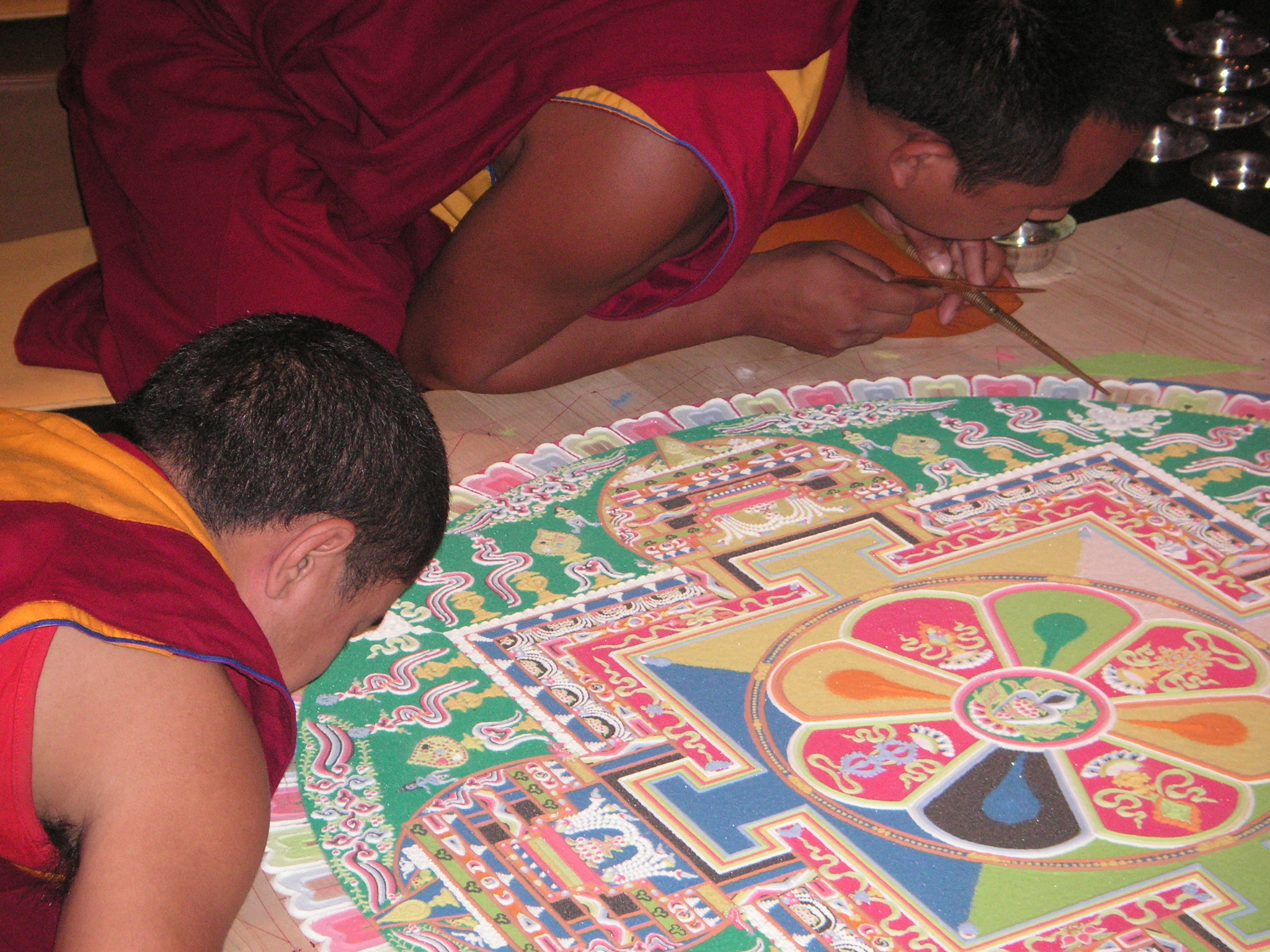
Can you imagine spending several hours, days, or even weeks on a work of art, and then destroying it? The idea of creating something only to wipe it out when you’re finished is illogical and counterproductive to many people in the Western world. But in some cultures, this is a common procedure, and one that serves a deeper purpose than meets the eye.
Sand painting is the perfect example of ephemeral art – that is, art that is meant to be temporary. To create a sand painting, colored sand is poured carefully into predetermined patterns. Sand painting is a common practice amongst many diverse indigenous cultures from around the world, including the Australian Aborigines, the Native Americans, and the Tibetans, as shown above. Tibetan sand painting is a perfect example of making art that values ‘process’ over ‘product’. In the Western world, it’s often the opposite – artists labor over paintings for the purpose of selling them for profit. The art, even though it may be a labor of love, is also a ‘product’. The ‘process’ of making art is treated as a means to an end. In Tibetan sand painting, the process of creating the intricate sand mandalas is far more important than the final product. Tibetan sand paintings are created by Buddhist monks for ritual purposes related to healing and blessing. As the sand mandalas are painstakingly created, viewers are often allowed to watch and admire the precision of the artists and the beauty of the design. Destroying the finished sand mandalas contains a ritual purpose as well; it is a lesson on impermanence. Perhaps artists from Western cultures can benefit from some of these ideas by paying closer attention to the process of making art, rather than worrying about how the final product will turn out.
Article Source: http://www.articlesbase.com/art-articles/the-art-of-tibetan-sand-painting-4297166.html
About the Author
Mark Feldman is President of SegTech, a company devoted to a wonderful Image Segmentation technology called Segmation. Segmation – The Art of Pieceful Imaging
Paint-by-numbers meets modern technology in SegPlay® PC, a computerized paint-by-numbers program for Windows 7, Vista, XP and 2000. With twenty built in images and powerful features for artsy types and casual gamers, SegPlay® PC is simple to use with infinite variety.
There are also hundreds of available add-on patterns for SegPlay® PC organized in over 100 categories from famous historical artists to colorful illustrations to natural photographic scenery.
Play online for free!
Visit our website: http://www.segmation.com
Read our blog: http://segmation.wordpress.com
Join us on Facebook: http://www.facebook.com/segmation
——————————————————————————————————–
I look forward to your thoughts and comments!
Be sure to Subscribe to this blog either by RSS or Email via the forms on the top right column of the page.
Like this:
Like Loading...